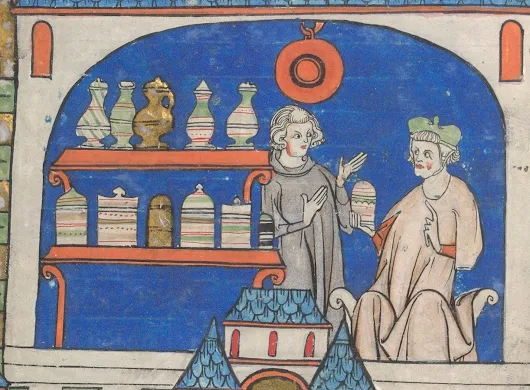
Precise details about the transmission of knowledge from one place to another are rarely determinable. For alchemy, however, historians have an exact date: February 11, 1144, when Robert of Chester—a noted 12th-century translator from England—recorded in his diary that he had just finished translating into Latin an Arabic book with the English title "The Book of the Composition of Alchemy".
Robert of Chester notes in his introduction to the book on alchemy that this was a new science in the West. As such, he was also responsible for the introduction of numerous Arabic words into Latin—words without any earlier Latin equivalent—and, from there, into English and other European languages. Among the most obvious is the word “alchemy” itself.
Sir Isaac Newton, one of the most influential scientists in history, spent far more time working on and writing about alchemical experiments than he did on physics or optics, subjects for which he’s far better known.
After reading Newton’s 17th- and 18th-century writings on alchemy, 20th-century economist John Maynard Keynes offered the opinion that “Newton was not the first of the age of reason, he was the last of the magicians.”
During Newton’s lifetime, fraudsters and successful attempts to defraud wealthy investors led to the banning of certain alchemical practices. The British Parliament was sufficiently worried about the potential devaluation of gold that unsanctioned alchemy could be punished by public hanging.
After 1720, a more rigid distinction between alchemy and chemistry was drawn. Within a few decades, the word “alchemy” came to refer only to the attempt to make gold from base metals. From that point forward, alchemists were seen as charlatans or fools.
Christian Church attitude to illness: Blame the victim & peddle fakery: Religion & contra-rational regression
The ascendancy of the Christian Church dates from around the time of the death of Galen. Having progressed so far, rational medicine was now abandoned. Medicine in the Bible is entirely supernatural. The Church developed the view that real practical medicine savoured of black magic. In any case it was wrong to try to subvert God's holy will by interfering with the natural course of events. It was God who caused illness. He was responsible for cures just as he was responsible for death. Even church law mentioned, in passing, that diseases were attributable to God, for example
If, by divine judgment, leprosy happens to a husband or wife, and the sick one demands the carnal debt from the one who is healthy, what is demanded must be rendered in accord with the Apostle's general commandment [1 Cor. 7:3-4], which gives no exception for this case.
(Decretals of Pope Gregory IX , Book Four, Title VIII C2)
Illness was indisputably caused by sin. The Bible said so, and so did Church Councils. The only alternative explanations given credence were diabolical possession, witchcraft and other satanic machinations. In Christendom, from AD 300 to around 1700 all serious mental conditions were understood as symptoms of demonic possession. Since illness was thought to be caused by supernatural agents, cures had to be essentially supernatural as well. Every cure was literally miraculous, and these miracles could be effected only by prayer, penance and the assistance of saints. To claim otherwise was heretical and blasphemous.
The Christian ideal was that women should die rather than allow themselves to be helped by a physician. Some women won their sainthood for doing no more than declining medical assistance. In the fourth century Saint Gorgonia, the daughter of two saints, was trampled by a team of mules, causing multiple broken bones and crushed internal organs. She would not see a doctor, as she thought it indecent. According to Christian sources this modesty miraculously cured her, and a second such self-healing miracle assured her sainthood. Today, Gorgonia is a patron saint for people afflicted by bodily ills. We do not know how many thousands of other women with identically modest Christian scruples died following her example and are now forgotten. http://www.badnewsaboutchristianity.com/gg0_medicine.htm
The ascendancy of the Christian Church dates from around the time of the death of Galen. Having progressed so far, rational medicine was now abandoned. Medicine in the Bible is entirely supernatural. The Church developed the view that real practical medicine savoured of black magic. In any case it was wrong to try to subvert God's holy will by interfering with the natural course of events. It was God who caused illness. He was responsible for cures just as he was responsible for death. Even church law mentioned, in passing, that diseases were attributable to God, for example
If, by divine judgment, leprosy happens to a husband or wife, and the sick one demands the carnal debt from the one who is healthy, what is demanded must be rendered in accord with the Apostle's general commandment [1 Cor. 7:3-4], which gives no exception for this case.
(Decretals of Pope Gregory IX , Book Four, Title VIII C2)
Illness was indisputably caused by sin. The Bible said so, and so did Church Councils. The only alternative explanations given credence were diabolical possession, witchcraft and other satanic machinations. In Christendom, from AD 300 to around 1700 all serious mental conditions were understood as symptoms of demonic possession. Since illness was thought to be caused by supernatural agents, cures had to be essentially supernatural as well. Every cure was literally miraculous, and these miracles could be effected only by prayer, penance and the assistance of saints. To claim otherwise was heretical and blasphemous.
The Christian ideal was that women should die rather than allow themselves to be helped by a physician. Some women won their sainthood for doing no more than declining medical assistance. In the fourth century Saint Gorgonia, the daughter of two saints, was trampled by a team of mules, causing multiple broken bones and crushed internal organs. She would not see a doctor, as she thought it indecent. According to Christian sources this modesty miraculously cured her, and a second such self-healing miracle assured her sainthood. Today, Gorgonia is a patron saint for people afflicted by bodily ills. We do not know how many thousands of other women with identically modest Christian scruples died following her example and are now forgotten.
Plague writers who "predicted" coronavirus pandemic .
In the 17th, 18th, and 19th centuries, some plague doctors and physicians wore a beak-like mask which was filled with aromatic items. The masks were designed to protect them from putrid air, which (according to the miasmatic theory of disease) was seen as the cause of infection. The design of these clothes has been attributed to Charles de Lorme, the chief physician to Louis XIII.
Many ancient cultures used molds, soil, and plants to treat bacterial infections. Tetracycline has been found in human skeletal remains in Egypt and the Sudan that are some 1,500 years old; it is speculated that it was present in materials consumed in the diet (Aminov). In ancient Serbia, Greece, and China, moldy bread was pressed against wounds to prevent infection. In Egypt, crusts of moldy wheat bread were applied on pustular scalp infections and “medicinal earth” was dispensed for its curative properties (Keyes). These remedies were believed to influence the spirits or the gods responsible for illness and suffering. Today we know that the occasional efficacy of these early treatments was due to the active metabolites and chemicals present in these concoctions, such as antimicrobial substances produced by the molds on bread.
Patent Medicines and Chemical Weapons
People living before the antibiotic era depended mainly on their immune system to survive infectious disease. However, they often sought a variety of largely untested remedies to treat their illnesses. These concoctions were of highly variable efficacy and safety and sometimes had no connection with the cure or relief from disease conditions. They were nonetheless patented, sold, and utilized by desperate people with no suitable alternatives.
The medieval Soutra hospital was built just off the Royal Road; the main route between England and Scotland, and dates back to 12th century. It was run by Augustinian monks looking after the poor, travellers, pilgrims and the elderly, as well as those who were unwell.
Dr Brian Moffat, led an excavation at Soutra Aisle during the 1980’s , and has led the Soutra Research Project since then. Dig findings from Soutra shed light on how those with psychiatric illnesses were treated, how epidemics were managed, and how dentistry and surgery in the Middle Ages was carried out. Surgeons’ Hall Museums are delighted to welcome Dr Moffat, lead archaeologist on the excavation, as he discusses the findings and sheds light of the mysteries of medical care in the middle ages.
Blame the victim & peddle fakery: Religion & contra-rational regression
The ascendancy of the Christian Church dates from around the time of the death of Galen. Having progressed so far, rational medicine was now abandoned. Medicine in the Bible is entirely supernatural. The Church developed the view that real practical medicine savoured of black magic. In any case it was wrong to try to subvert God's holy will by interfering with the natural course of events. It was God who caused illness. He was responsible for cures just as he was responsible for death. Even church law mentioned, in passing, that diseases were attributable to God, for example
If, by divine judgment, leprosy happens to a husband or wife, and the sick one demands the carnal debt from the one who is healthy, what is demanded must be rendered in accord with the Apostle's general commandment [1 Cor. 7:3-4], which gives no exception for this case.
(Decretals of Pope Gregory IX , Book Four, Title VIII C2)
Illness was indisputably caused by sin. The Bible said so, and so did Church Councils. The only alternative explanations given credence were diabolical possession, witchcraft and other satanic machinations. In Christendom, from AD 300 to around 1700 all serious mental conditions were understood as symptoms of demonic possession. Since illness was thought to be caused by supernatural agents, cures had to be essentially supernatural as well. Every cure was literally miraculous, and these miracles could be effected only by prayer, penance and the assistance of saints. To claim otherwise was heretical and blasphemous.
The Christian ideal was that women should die rather than allow themselves to be helped by a physician. Some women won their sainthood for doing no more than declining medical assistance. In the fourth century Saint Gorgonia, the daughter of two saints, was trampled by a team of mules, causing multiple broken bones and crushed internal organs. She would not see a doctor, as she thought it indecent. According to Christian sources this modesty miraculously cured her, and a second such self-healing miracle assured her sainthood. Today, Gorgonia is a patron saint for people afflicted by bodily ills. We do not know how many thousands of other women with identically modest Christian scruples died following her example and are now forgotten.
This manuscript includes a collection of recipes, charms, and surgical operations by the surgeon John of Arderne (1307-1376). The page displayed here shows a series of drawings of medicinal plants. John of Arderne was the first English surgeon to become famous throughout the world for his work. He attended English troops at various battles in the Hundred Years War, which gave him the exceptional opportunities to treat injuries and to study the anatomy of corpses. Compared with the pictures in most earlier books of this kind, these drawings are extremely precise and true to nature. Among the well-known plants on this page is the daffodil, labelled 'Affadille' (top row, third from left). http://www.bl.uk/learning/timeline/item126570.html
An abortifacient is a substance that induces abortion. Numerous non-pharmaceutical abortifacients existed during the pre-pharmaceutical era. These included herbal, mineral, and ritualistic or spiritual preparations. Their effectiveness is difficult to determine. Of those that remain in use in the modern day, some are considered effective to a lesser or greater degree; while others are very effective, but carry negative side effects (primarily toxicity) which keep them from wider prevalence.
Today, many herbs and plants sold "over the counter" are claimed to act as abortifacients, either by themselves or if taken in certain doses or mixtures. Examples include brewer's yeast, vitamin C, bitter melon, wild carrot, blue cohosh, pennyroyal, nutmeg, mugwort, papaya, vervain, common rue, ergot, saffron and tansy. Animal studies have shown that pomegranate may be an effective abortifacient.
n English law, abortion did not become illegal until 1803. English folk practice before and after that time held that fetal life was not present until quickening. "Women who took drugs before that time would describe their actions as 'restoring the menses' or 'bringing on a period'." Abortifacients used by women in England in the 19th century (not necessarily safe or effective) included diachylon, savin, ergot of rye, pennyroyal, nutmeg, rue, squills, and hiera picra, the latter being a mixture of powdered aloe and canella.
Heal-all is a perennial herb found throughout Europe, Asia and North America, as well as most temperate climates. In Ireland it is generally abundant.
Prunella vulgaris (known as common self-heal , heal-all, woundwort, heart-of-the-earth, carpenter's herb, brownwort and blue curls) is an herbaceous plant in the genus Prunella.
Self-heal is edible: the young leaves and stems can be eaten raw in salads; the plant in whole can be boiled and eaten as a potherb; and the aerial parts of the plant can be powdered and brewed in a cold infusion to make a beverage.
Medieval medicine is neither a precursor to our modern medicine, nor a simplistic, primitive system. There are few similarities between medieval and modern medicine, especially in regard to the framework through which each approaches illness. During the medieval period, the body reflected one's state of health, and medieval doctors relied on the body as text.
However, medieval doctors had little concept of germs as the medium of disease and the cause of illness. While the body was known to degenerate with age, medieval doctors believed that a healthy body required a state of harmony or balance. An unhealthy body represented an imbalance, usually identified through a change or sign on the outside of the body, either on the skin or from an excreted fluid, such as urine. Thus the body becomes the symbolic text which a doctor needed to interpret in order first to diagnosis and then to cure.
Lacking any concept of viruses or bacteria as causes of illness, medieval doctors were left to reason that certain behaviors led to illness. There were three types of possible illnesses: those caused by the body's natural degeneration, those to which the body was predisposed, and those caused by immoderate living.
The connection between morality and illness is not a medieval creation, but part of the heritage of Greco-Roman medicine. Galen unified two competing theories, the Empiricists and the Dogmatists into one philosophy which became the foundation of medieval medicine. The Empiricists believed in experience as the greatest teacher of medical learning. The Dogmatists relied on a learned tradition and propounded a notion of a microcosm and macrocosm. The microcosm consisted of the four bodily humours: blood, phlegm, black bile, and yellow bile. Each of the four humours reflected the elements of the macrocosm: air, water, earth, and fire, respectively. The humours also had temperature and moisture properties. Blood was hot and wet, phlegm was cold and wet, black bile was cold and dry, and yellow bile was hot and dry. According to this theory, when a person became sick, one of the four humours was out of balance. To balance the humours, one needed to take a prescription, usually made from some combination of plants or animals. Doctors categorized all plants and animals by their temperature and moisture.
Galen believed that authoritative learning was important but must not be accepted blindly; "rather, [medical authorities] are authorities in as far as they are proved right" through clinical experience. Essentially, Galen saw medicine as a cumulative process in which one studied medical authorities and appended or altered the authoritative corpus through clinical experience. Galen's emphasis on immoderation as a cause of illness appealed especially to early Christians.
A third misconception about medieval medicine concerns ascribing the belief to medieval people that all illness was connected to moral failings. In fact, some illnesses were believed to occur naturally or as a result of old age.
The clearest literary example of both the influence of medicine on literature and the connection between morality and illness appears in our own adjectives: sanguine, choleric, phlegmatic, and melancholy. At one time, these adjectives referred both to the emotional and moral state of the individual as well as to his or her physical constitution. Each ... ailment corresponds to an emotional state--an emotional state that could lend itself to sin. The assumptions which underlie this poem are that the phlegmatic is prone to the sin of idleness, the sanguine is prone to the sins of lust and overindulgence, the choleric is prone to the sins of covetousness, and the melancholic is prone to the sins of deceit and envy. https://web.archive.org/web/20050306190053/http://www.the-orb.net:80/non_spec/missteps/ch4.html