
Showing posts with label legal. Show all posts
Showing posts with label legal. Show all posts
Spanish Inquisition
Ugly History: Spanish Inquisition - TED-Ed > .
In 1478, Pope Sixtus IV issued a decree authorizing the Catholic monarchs, Ferdinand and Isabella, to root out "heresy" in the Spanish kingdoms. The inquisition quickly turned its attention to ridding the region of people who were not part of the Catholic Church— leading to more than 350 years of ethnic cleansing. Kayla Wolf digs into the persecution and brutality of the Spanish Inquisition.

𝕸 Power Structures
Estates of the Realm ..
Chivalry ..
Church upheavals ..
Church and Crown to Parliament ..
Chivalry ..
Church upheavals ..
Church and Crown to Parliament ..
Coronations ➧
Court - Middle Ages ..
Criticism of Late Medieval Religion ..
Earl Marshall ..
Court - Middle Ages ..
Criticism of Late Medieval Religion ..
Earl Marshall ..
Evolution of English Law ..
‘Good Parliament’ of 1376 ..
Heraldry ..
English heraldry ..
KG - Knights of the Garter ..
Walsingham (Elizabeth I's spymaster) ..
‘Good Parliament’ of 1376 ..
Heraldry ..
English heraldry ..
KG - Knights of the Garter ..
Walsingham (Elizabeth I's spymaster) ..
Educational Systems
Church upheavals
Milestones in Crowd Control
Medieval Antisemitism: An Introduction ~Dr Lackner > .
523-4 – Boethius writes The Consolation of Philosophy
Anicius Manlius Severinus Boëthius, a Roman senator and official, is imprisoned by King Theodoric the Great. As he awaits his trial, Boethius writes this philosophical treatise, which examines various questions, including why bad things happen to good people. It has since become a major work of philosophy.
525 – Anno Domini calendar invented
A monk named Dionysius Exiguus creates this new dating system as part of his efforts to understand the dating of Easter. It wanted the year 1 AD to be the date when Jesus Christ was born, although later calculations show that his birth occurred before this. Gradually use of this calendar became more widespread, and is now the most widely accepted system for counting years in the world.
529-34 – Code of Justinian issued
A set of laws created during the reign of the Byzantine Emperor Justinian I, it is considered an important milestone in the history of law.
563 – St Columbus founds Iona
The Irish missionary Columba and 12 companions set up a monastery on the Isle of Iona, just off the Scottish coast. This event marks an important point in the development of Christianity in the British Isles and the rise of monasticism in Western Europe.
590 – Gregory the Great becomes Pope
Gregorius Anicius is elected Pope, taking the name Gregory I. He would reign until 604, and would undertake a series of measures that strengthened the role of the Papacy and spread the Christian religion.
https://www.youtube.com/watch?v=mBCUeZVuyxQ .
https://www.youtube.com/watch?v=dcPK5dp2dfQ .
https://www.youtube.com/watch?v=ZPnDcMbFXaM .
https://www.youtube.com/watch?v=ZVpDSz8BRBk .
Anglo-Saxon Primary Sources - VoP >> .
735 – Bede, Historia ecclesiastica gentis Anglorum
Venerable Bede, an Anglo-Saxon Benedictine scholar, writes the History of the English Church and People in Latin, perhaps the best historical writing of medieval history.
https://www.youtube.com/watch?v=mBCUeZVuyxQ
? https://www.youtube.com/results?search_query=Historia+ecclesiastica+gentis+Anglorum ?
793 – Vikings raid Lindisfarne
Raiders from Scandinavia attack a monastery at Lindisfarne. It is seen as the beginning of Norse attacks and expansion in Europe.
910 – Cluny Abbey founded
Founded by William I, Duke of Aquitaine, this French monastery would become an important centre of Christianity in the Middle Ages.
1054 – Great Schism
An official break between the Roman Catholic Church and Eastern Orthodox churches which lasts to the present-day.
1095 – First Crusade is launched
At the Council of Clermont, Pope Urban II calls upon Christians to undertake a military expedition in support of the Byzantine Empire against the Seljuk Turks. It would lead to the conquest of Jerusalem four years later and a concerted effort by Western Europeans to take control of the Near East.
1098 – Cistercians founded
Robert, abbot of Molesme, establishes a new religious order in Cîteaux. The Cistercians offered a different kind of monastic reform that would be popular in medieval Europe.
1215 – Fourth Lateran Council
Invoked by Pope Innocent III, this meeting would see hundreds of bishops and religious figures attend, and bring about sweeping changes to Catholic doctrine.
1215 – Magna Carta
A charter agreed to by King John of England and his rebellious barons, the document would come to be seen as the beginning of legal limits on the power of monarchs.
1216 – Dominican Order
The Dominican order is founded by St. Dominic of Spain and is authorized by Innocent III. Its purpose is to convert Muslims and Jews and to put an end to heresy. The Dominicans eventually become the main administrators of inquisitorial trials.
1265 – Thomas Aquinas begins his Summa Theologiae
This Dominican friar does not complete this massive work before his death in 1274, but the text has become one of the most important works on theology.
Thomas Aquinas 1 > .Thomas Aquinas 2 > .
1378 – Western Schism begins
A split within the Catholic churches that would see two or three men claiming to be Pope at the same time.
http://www.medievalists.net/2018/04/most-important-events-middle-ages/
https://www.historyextra.com/period/norman/10-medieval-dates-you-need-to-know/
https://en.wikipedia.org/wiki/Timeline_of_the_Middle_Ages
http://www.thelatinlibrary.com/imperialism/notes/middleageschron.html
50 Most Important Events of the Middle Ages .
Medieval Antisemitism: An Introduction ~Dr Lackner > .
523-4 – Boethius writes The Consolation of Philosophy
Anicius Manlius Severinus Boëthius, a Roman senator and official, is imprisoned by King Theodoric the Great. As he awaits his trial, Boethius writes this philosophical treatise, which examines various questions, including why bad things happen to good people. It has since become a major work of philosophy.
525 – Anno Domini calendar invented
A monk named Dionysius Exiguus creates this new dating system as part of his efforts to understand the dating of Easter. It wanted the year 1 AD to be the date when Jesus Christ was born, although later calculations show that his birth occurred before this. Gradually use of this calendar became more widespread, and is now the most widely accepted system for counting years in the world.
529-34 – Code of Justinian issued
A set of laws created during the reign of the Byzantine Emperor Justinian I, it is considered an important milestone in the history of law.
563 – St Columbus founds Iona
The Irish missionary Columba and 12 companions set up a monastery on the Isle of Iona, just off the Scottish coast. This event marks an important point in the development of Christianity in the British Isles and the rise of monasticism in Western Europe.
590 – Gregory the Great becomes Pope
Gregorius Anicius is elected Pope, taking the name Gregory I. He would reign until 604, and would undertake a series of measures that strengthened the role of the Papacy and spread the Christian religion.
https://www.youtube.com/watch?v=dcPK5dp2dfQ .
https://www.youtube.com/watch?v=ZPnDcMbFXaM .
https://www.youtube.com/watch?v=ZVpDSz8BRBk .
Anglo-Saxon Primary Sources - VoP >> .
735 – Bede, Historia ecclesiastica gentis Anglorum
Venerable Bede, an Anglo-Saxon Benedictine scholar, writes the History of the English Church and People in Latin, perhaps the best historical writing of medieval history.
https://www.youtube.com/watch?v=mBCUeZVuyxQ
? https://www.youtube.com/results?search_query=Historia+ecclesiastica+gentis+Anglorum ?
793 – Vikings raid Lindisfarne
Raiders from Scandinavia attack a monastery at Lindisfarne. It is seen as the beginning of Norse attacks and expansion in Europe.
910 – Cluny Abbey founded
Founded by William I, Duke of Aquitaine, this French monastery would become an important centre of Christianity in the Middle Ages.
1054 – Great Schism
An official break between the Roman Catholic Church and Eastern Orthodox churches which lasts to the present-day.
1095 – First Crusade is launched
At the Council of Clermont, Pope Urban II calls upon Christians to undertake a military expedition in support of the Byzantine Empire against the Seljuk Turks. It would lead to the conquest of Jerusalem four years later and a concerted effort by Western Europeans to take control of the Near East.
1098 – Cistercians founded
Robert, abbot of Molesme, establishes a new religious order in Cîteaux. The Cistercians offered a different kind of monastic reform that would be popular in medieval Europe.
1215 – Fourth Lateran Council
Invoked by Pope Innocent III, this meeting would see hundreds of bishops and religious figures attend, and bring about sweeping changes to Catholic doctrine.
1215 – Magna Carta
A charter agreed to by King John of England and his rebellious barons, the document would come to be seen as the beginning of legal limits on the power of monarchs.
1216 – Dominican Order
The Dominican order is founded by St. Dominic of Spain and is authorized by Innocent III. Its purpose is to convert Muslims and Jews and to put an end to heresy. The Dominicans eventually become the main administrators of inquisitorial trials.
1265 – Thomas Aquinas begins his Summa Theologiae
This Dominican friar does not complete this massive work before his death in 1274, but the text has become one of the most important works on theology.
Thomas Aquinas 1 > .Thomas Aquinas 2 > .
1378 – Western Schism begins
A split within the Catholic churches that would see two or three men claiming to be Pope at the same time.
http://www.medievalists.net/2018/04/most-important-events-middle-ages/
https://www.historyextra.com/period/norman/10-medieval-dates-you-need-to-know/
https://en.wikipedia.org/wiki/Timeline_of_the_Middle_Ages
http://www.thelatinlibrary.com/imperialism/notes/middleageschron.html
50 Most Important Events of the Middle Ages .
Church and Crown to Parliament
Henry II and Becket
https://www.youtube.com/watch?v=_EKUIBz_po0 .
Magna Carta
https://www.youtube.com/watch?v=mDZBNwpYmfQ .
First Parliaments
https://www.youtube.com/watch?v=8M9LCXI-V0I .
Peasants Revolt
https://www.youtube.com/watch?v=D3EzLF2rOKY .
Magna Carta
https://www.youtube.com/watch?v=mDZBNwpYmfQ .
First Parliaments
https://www.youtube.com/watch?v=8M9LCXI-V0I .
Peasants Revolt
https://www.youtube.com/watch?v=D3EzLF2rOKY .
The Lords Appellant

The Lords Appellant were a group of nobles in the reign of King Richard II, who, in 1388, sought to impeach some five of the King's favourites in order to restrain what was seen as tyrannical and capricious rule. The word appellant simply means '[one who is] appealing [in a legal sense]'. It is the older (Norman) French form of the present participle of the verb appeler, the equivalent of the English 'to appeal'. The group was called the Lords Appellant because its members invoked a procedure under law to start prosecution of the king's unpopular favourites known as 'an appeal': the favourites were charged in a document called an appeal of treason, a device borrowed from civil law which led to some procedural complications.
The Lords Appellant Part 1: A Great and Continual council
There were originally three Lords Appellant:
Thomas of Woodstock, Duke of Gloucester, son of Edward III and thus the king's uncle.
Richard FitzAlan, Earl of Arundel and of Surrey.
Thomas de Beauchamp, Earl of Warwick.
These were later joined by
Henry Bolingbroke, Earl of Derby (the future king Henry IV)
Thomas de Mowbray, Earl of Nottingham.
Archbishop of York, Alexander Neville.
The favourites
Thomas de Beauchamp, Earl of Warwick.
These were later joined by
Henry Bolingbroke, Earl of Derby (the future king Henry IV)
Thomas de Mowbray, Earl of Nottingham.
Archbishop of York, Alexander Neville.
The favourites
Nicholas Brembre.
John de Beauchamp, 1st Baron Beauchamp (4th creation).
Sir James Berners.
Sir John Salisbury.
John de Beauchamp, 1st Baron Beauchamp (4th creation).
Sir James Berners.
Sir John Salisbury.
Neville
 |
| Neville-Warwick Arms. |
The House of Neville (also the House of Nevill) is a noble house of early medieval origin, which was a leading force in English politics in the later Middle Ages. The family became one of the two major powers in northern England, along with the House of Percy, and played a central role in the Wars of the Roses. (Heraldry)
Born in about 1340, Alexander Neville was a younger son of Ralph Neville, 2nd Baron Neville de Raby and Alice de Audley. He was a member of the Neville family, one of the most powerful families in the north of England.
Neville's first known ecclesiastical appointment was as a canon of York Minster, holding the prebendary of Bole from 1361 to 1373. He became a claimant to the Archdeaconry of Cornwall from 1361 until it was set aside in 1371, becoming instead Archdeacon of Durham from circa 1371 to 1373.
On the Lords Appellant rising against King Richard II in 1386, however, Neville was accused of treason and it was determined to imprison him for life in Rochester Castle.
Neville fled, and Pope Urban VI, pitying his case, translated him to the Scottish see of St. Andrews on 30 April 1388. However, he never took possession of the see because the Scots acknowledged the Avignon papacy with their own candidate, Walter Trail.
For the remainder of Neville's life he served as a parish priest in Leuven, where he died in May 1392 and was buried there in the Church of the Carmelites.
Ralph Neville, 1st Baron Neville de Raby.
John Neville, 3rd Baron Neville de Raby.
George Neville, Archbishop of York (c.1432-1476)
George Neville, Archbishop of York and Chancellor of England, was the youngest son of Richard Neville, Earl of Salisbury, and brother of Richard Neville, Earl of Warwick, known as the "Kingmaker."
Formal Education in the Middle Ages
Educational Routes circa 1000 ..
Formal Education in the Middle Ages ..
Héloïse and Abelard ..
Learning, Work ..
Formal Education in the Middle Ages ..
Héloïse and Abelard ..
Learning, Work ..
1642 English Civil War 1651
.
Origins - Why English Civil War Happened - K&G > .Britain Hasn't Always Had a Monarchy - Tom N > . skip > .
English Civil War - K&G >> .
The English Civil War (1642–1651) was a series of civil wars and political machinations between Parliamentarians ("Roundheads") and Royalists ("Cavaliers"), mainly over the manner of England's governance and issues of religious freedom. It was part of the wider Wars of the Three Kingdoms. The first (1642–1646) and second (1648–1649) wars pitted the supporters of King Charles I against the supporters of the Long Parliament, while the third (1649–1651) saw fighting between supporters of King Charles II and supporters of the Rump Parliament. The wars also involved the Scottish Covenanters and Irish Confederates. The war ended with Parliamentarian victory at the Battle of Worcester on 3 September 1651.
Unlike other civil wars in England, which were mainly fought over who should rule, these conflicts were also concerned with how the three Kingdoms of England, Scotland and Ireland should be governed. The outcome was threefold: the trial of and execution of Charles I (1649); the exile of his son, Charles II (1651); and the replacement of English monarchy with the Commonwealth of England, which from 1653 (as the Commonwealth of England, Scotland, and Ireland) unified the British Isles under the personal rule of Oliver Cromwell (1653–1658) and briefly his son Richard (1658–1659). In England, the monopoly of the Church of England on Christian worship was ended, and in Ireland, the victors consolidated the established Protestant Ascendancy. Constitutionally, the outcome of the wars established the precedent that an English monarch cannot govern without Parliament's consent, though the idea of Parliamentary sovereignty was legally established only as part of the Glorious Revolution in 1688.
English Civil War - K&G >> .
The English Civil War (1642–1651) was a series of civil wars and political machinations between Parliamentarians ("Roundheads") and Royalists ("Cavaliers"), mainly over the manner of England's governance and issues of religious freedom. It was part of the wider Wars of the Three Kingdoms. The first (1642–1646) and second (1648–1649) wars pitted the supporters of King Charles I against the supporters of the Long Parliament, while the third (1649–1651) saw fighting between supporters of King Charles II and supporters of the Rump Parliament. The wars also involved the Scottish Covenanters and Irish Confederates. The war ended with Parliamentarian victory at the Battle of Worcester on 3 September 1651.
Unlike other civil wars in England, which were mainly fought over who should rule, these conflicts were also concerned with how the three Kingdoms of England, Scotland and Ireland should be governed. The outcome was threefold: the trial of and execution of Charles I (1649); the exile of his son, Charles II (1651); and the replacement of English monarchy with the Commonwealth of England, which from 1653 (as the Commonwealth of England, Scotland, and Ireland) unified the British Isles under the personal rule of Oliver Cromwell (1653–1658) and briefly his son Richard (1658–1659). In England, the monopoly of the Church of England on Christian worship was ended, and in Ireland, the victors consolidated the established Protestant Ascendancy. Constitutionally, the outcome of the wars established the precedent that an English monarch cannot govern without Parliament's consent, though the idea of Parliamentary sovereignty was legally established only as part of the Glorious Revolution in 1688.
Battle of Radcot Bridge

Battle of Radcot Bridge 1387-12-19
The Battle of Radcot Bridge was fought on 19 December 1387 at Radcot Bridge in England, a bridge over the River Thames now in Oxfordshire but then the boundary between Oxfordshire and Berkshire. It was fought between troops loyal to Richard II, led by court favourite Robert de Vere, and an army captained by Henry Bolingbroke, Earl of Derby.
Timeline:
1386
• July – John of Gaunt leaves England to make good his claim to the Crown of Castile.
https://mittelzeit.blogspot.com/2019/03/john-of-gaunt-1st-duke-of-lancaster.html
• October – the Wonderful Parliament is held, and appoints a commission to oversee the court and government.
1387
• 24 March – Hundred Years' War: A Franco-Castilian fleet is defeated off Margate.
• 14 November – a group of powerful nobles known as Lords Appellant raise arms against the King, demanding the arrest of members of the royal court.
• 20 December – Battle of Radcot Bridge: Lords Appellant defeat Richard's army. The king is imprisoned until he agrees to replace all the councillors in his court.
1388
• February – the entire court of King Richard II is convicted of treason by the Merciless Parliament, under the influence of the Lords Appellant, and are all either executed or exiled. Richard II effectively becomes a puppet of the Lords Appellant.
The Battle of Radcot Bridge
During the troubled times of King Richard II's reign, when his uncles and their allies, the 'Lords Appellant' were trying to impose their will on the immovable King, the young monarch did loose power for a short time in the Winter of 1387-88. Thomas of Woodstock, Duke of Gloucester, the King's uncle and chief adversary, took the opportunity to accuse the Richard's favourite, Robert De Vere, Earl of Oxford, of treason. De Vere escaped to the West Midlands where he gathered together an army of some fifteen thousand men. Quickly, he marched them south to both defend himself and reinforce the King's followers in London.
Gloucester immediately led troops north to close the roads from the Midlands and the King's western reinforcements, originally heading for Burford, found themselves obliged to head quickly south. Gloucester's deputy and nephew, Henry Bolingbroke, the Earl of Derby (later to become King Henry IV), had taken up a more southerly position, along with Thomas de Mowbray, the Earl Marshal. They blocked off any route across the Thames by encamping on the island between the Pidnell and Radcot Bridges on the Berkshire-Oxfordshire border, near Faringdon. Bolingbroke was a cousin of De Vere's repudiated wife (Philippa de Coucy). He regarded him as a scoundrel and yearned to meet him in the open field.
De Vere's army arrived at the twin Thames bridges, only to find the first sabotaged and the second guarded by Derby's troops. Gloucester's men were still closing in from the north. The Royalists turned and deserted at the first shock of Bolingbroke's pikes. They could only surrender or else make desperate rushes over or through the river in an attempt to escape. Mounting a fresh horse, De Vere pushed forward but, with Pidnell Bridge demolished, the terrified Earl was forced to have his mount leap into the river and face up stream. Hugging the bank, he lightened his load by dropping his gauntlets, sword and casque. At Radcot Bridge, stood a company of archers. Dodging their deadly arrows through the stream again, he sought a ford but none was to be found. As night came on, he slipped from his horse, put off his cuirass, plunged into the stream, and swimming across, escaped with the loss of everything but life and limb.
Hiding in the woods by day, De Vere stole away into the western shires where, for a while, he was safe. His enemies believed him dead. Horse, casque, sword and cuirass being found next morning by the riverbank, his pursuers fancied that he had been drowned. However, he eventually managed to flee to France, where he died in exile. With their victory at Radcot Bridge, the 'Lords Appellant' were able to gain a short-lived control over the country. This culminated in the merciless parliament in which King Richard's main allies were condemned.
Pidnell is the more northerly of the two bridges and Radcot the southerly, while the villages are the other way round. The present Radcot Bridge, spanning the southern branch of the River Thames and the Berkshire-Oxfordshire Boundary, is of 14th century date and is therefore the one that stood during the battle.
Background:
In August 1387 King Richard retaliated; he assembled a Council of magistrates at Nottingham and attempted to redefine the Royal Prerogative so as to render the Wonderful Parliament treasonous. The leaders of the Parliament, including Richard's uncle Thomas of Woodstock, Duke of Gloucester, hit back during the Miraculous Parliament of November 1387. During this session, Woodstock and the Earls of Warwick and Arundel submitted an appeal which accused several of Richard's closest friends of routinely deceiving the King for their own profit.
Richard responded by summoning Woodstock and the other Lords Appellant to the Tower of London; all three refused.
This was open dissent, and both Richard and the Appellants knew the implications of such defiance. According to the author of the Eulogium historiarum, Richard asked Woodstock whether his companions were willing to take arms against him, to which the Duke replied: "we do not rebel or arm ourselves against the King except in order to instruct him".
Pushed further by Richard, who protested that Parliament did not have the right to command a King even in the case of "the meanest kitchen boy", the Duke darkly reminded his nephew of his own standing: "But I am the son of a king".
Fearing deposition, King Richard ordered that the citizens of London should take up arms. De Vere was despatched to Cheshire, where King Richard had assembled an army of five thousand retainers, under the direct command of Sir Thomas Molineux, Constable of Chester. De Vere now took these southwards towards London.
The most direct routes to the capital were blocked by Arundel's men, so de Vere decided to cross the Thames at Radcot, near Faringdon. However, the bridge itself was under the guard of Derby's troops; they had also partly dismantled its structure. Undeterred, de Vere gave the command to storm the crossing. At this point, a larger force of Derby's men arrived from the north, effectively surrounding the Cheshiremen. De Vere managed to escape the field, eventually making his way to France; once it was known that he had fled, his army promptly surrendered. Among the handful of casualties was Molyneux himself, who was killed during the abortive attempt to cross the Thames.
After the battle, Woodstock and the other Appellants held a council with Richard at the Tower. Richard had no means of resisting their demands, and it was agreed that a further Parliament should be called in February 1388. The resulting Merciless Parliament saw a fullscale purge of Richard's household.
The Lords Appellant Part 2: Radcot Bridge
Merciless Parliament
The Merciless Parliament, a term coined by Augustinian chronicler Henry Knighton, refers to the English parliamentary session of February to June 1388, at which many members of Richard II's Court were convicted of treason. The session was preceded by a period in which Richard's power was revoked and the kingdom placed under the regency of the Lords Appellant. Richard had launched an abortive military attempt to overthrow the Lords Appellant and negotiate peace with the kingdom of France so he could focus all his resources against his domestic enemies. The Lords Appellant counteracted the attempt and called the Parliamentary session to expose his attempts to make peace. Parliament reacted with hostility and convicted almost all of Richard's advisers of treason. Most were executed and a few exiled. Parliament was dissolved after violence broke out in Kent and the Duke of York and his allies began objecting to some executions.
‘Good Parliament’ of 1376 ..
The Wonderful Parliament.
𝕸 First Estate
Estates of the Realm ..
Anchorites ..
Anchorites ..
1556-3-21 Archbishop Cranmer executed ..
Atheism - Medieval onward ..
Beguines ..
Benedictines ..
Convents in Medieval Britain ..
Council of Oxford, 1222 - clamping down on clerical concubines ..
Critics of Late Medieval Religion ..
Ecclesiastical Curse ..
Gloucester & Whitefriars ..
Beguines ..
Benedictines ..
Convents in Medieval Britain ..
Council of Oxford, 1222 - clamping down on clerical concubines ..
Critics of Late Medieval Religion ..
Ecclesiastical Curse ..
Marriage Act of 1836 ..
Terrain→Technology - Impact on History ⇼
Warrior Churchmen - medieval ..
Wycliffe, Tyndale, Cranmer, KJV ..
Wyclif & Lollards ..
1378 – Western Schism ..
Warrior Churchmen - medieval ..
Wycliffe, Tyndale, Cranmer, KJV ..
Wyclif & Lollards ..
1378 – Western Schism ..
Educational Systems
Cathedrals, Colleges, Universities ..
Educational Routes circa 1000 ..
Formal Education in the Middle Ages ..
Héloïse and Abelard ..
Learning, Work ..
Formal Education in the Middle Ages ..
Héloïse and Abelard ..
Learning, Work ..
Medieval Universities ..
Sociopolitical Evolution - West ➧
Student Life in the Medieval University ..
Universities - Medieval ..
University - Medieval ..
Student Life in the Medieval University ..
Universities - Medieval ..
University - Medieval ..
Falconry
Tudor Xmas ..
Food, Drink
Perks
Philosophy
Rapid Romp through Evolution of Philosophy ⇻Superstition

Marriage banns and marital bans
Marriage banns and marital bans
The original Catholic Canon law requiring marriage banns---intended to prevent clandestine marriages---was decreed in Canon 51 of the Lateran IV Council in 1215; until then, the public announcement in church of marriages to be contracted was only made in some areas.
.......
Pope Alexander III (1159-1181) decided to follow the recommendations of scholars at the University of Paris and ruled that marriage was created simply when spouses both said they were married. No priest, no witnesses and no ceremonies were required. Alexander III’s decision marks the high water mark of easy access to marriage. This rule – that you contracted marriage by speaking the marriage vows – continued in England until Lord Hardwick’s marriage act in 1753.
To many clerics and lawyers this all felt a bit too easy, so it was felt that something was needed to safeguard marriages contracted by words alone. In attempt to do so the Fourth Lateran Council passed the rules in 1215 which required the reading of banns in church on three consecutive Sundays. In doing so, the council introduced a final principle: marriage was not just a matter between individuals but an institution that was protected by the community. The fact that you were legally able to marry – that you were marrying of your own free will, that you were not already married, that you were not too closely related, and that you were old enough to make the decision to marry – was guaranteed and testified to by every member of the local community.
The banns of marriage, commonly known simply as the "banns" or "bans" (from a Middle English word meaning "proclamation", rooted in Frankish and from there to Old French), are the public announcement in a Christian parish church or in the town council of an impending marriage between two specified persons. It is commonly associated with the Catholic Church and the Church of England and with other denominations whose traditions are similar; in 1983, the Roman Catholic Church removed the requirement for banns and left it to individual national bishops' conferences to decide whether to continue this practice, but in most Catholic countries the banns are still published.
The purpose of banns is to enable anyone to raise any canonical or civil legal impediment to the marriage, so as to prevent marriages that are invalid. Impediments vary between legal jurisdictions, but would normally include a pre-existing marriage that has been neither dissolved nor annulled, a vow of celibacy, lack of consent, or the couple's being related within the prohibited degrees of kinship.
https://theconversation.com/reading-of-the-banns-how-the-church-tried-to-perfect-the-institution-of-marriage-51411
https://en.wikipedia.org/wiki/Banns_of_marriage
Anglo Saxon Sex
Medieval sex is far more often discussed in penitentials – lists of sins (according to the Church) and the various penances that confessors should give the perpetrators for committing them:
Had sex with another man’s wife? Fast for one winter
Had a wet dream? Sing 23 psalms
Had sex with a pig? Fast for seven years
We have no way of knowing how this related to real life practice. Just because a sex act is mentioned doesn’t mean that anyone actually performed it. We don’t know how often Anglo-Saxons had sex with pigs (if at all), whether they bothered to confess it to a priest, or whether the priest actually gave them the penance he was supposed to assign.
And, in theory, if you obeyed the Church, even marital sex was off the table for most of the year:
Not during Lent, Easter, Pentecost and various other feast and fast days
Not while the wife is menstruating
Not while the wife is heavily pregnant or for 40 days after she gives birth
Not on Tuesday, Thursday, Saturday and Sunday nights
Not during daylight
And the type of sex you could have was also limited:
No oral or anal sex
No masturbation
No positions other than the “missionary” position
No sex unless your express intent is to produce children and you’re not enjoying it too much
It seems unlikely that ordinary people obeyed these prohibitions to the letter, particularly since historians such as Bede describe monks and nuns giving the Church a bad name through their drinking, gluttony, and fornication. No, religious documents don’t tell the whole story.
So perhaps we get a clearer picture from the literary descriptions. Does the “onion” riddle prove that Anglo-Saxon peasant women were enthusiastic and active sexual partners (note those verbs: grabs, rushes, holds, claims)? Or does it represent some monk’s sexual fantasy? The answers are not obvious here either.
The final tricky area is to do with sexual identity. In the 21st century, Westerners often like to divide people into straight and gay (even now we struggle to come to grips with categories such as bisexuality, asexuality, sexual fluidity). But the gay-straight opposition is only about 130 years old. Before that, people tend to talk more about what they do rather than what they are. In fact, if medieval people did think much about sexual identity, they may have been more inclined to do so in terms of categories such as virginity and chastity.
And that’s what’s really exciting about the Anglo-Saxon period. It’s not just the joys of good (or bad) sex in literature. Reading texts produced over 1000 years ago can make us think wider and deeper than the binaries and labels we fight over today. Asking questions about the past, it turns out, might help us re-envision the present.
https://theconversation.com/and-the-winner-of-the-medieval-bad-sex-in-fiction-award-is-51288
Over the centuries, countless women in the Christian West have been defined by appearance or attire and have been variously objectified by those in authority over them.
Among these countless women, there is a particular group called “anchorites” (anchorites could be men, but were more frequently women). Anchorites, who were very common in England in the Middle Ages, were people who wanted to live lives of Christian prayer and extreme devotion to God. In order to do this, they allowed themselves to be permanently enclosed in small rooms (called “cells”) adjoining their local church and vowed themselves to a life of chastity and penance. Their enclosure began when they were literally bricked into their cells, and was meant to continue until the moment of their death. In fact, we have quite a few records of anchorites being buried within their own cells.
The original Catholic Canon law requiring marriage banns---intended to prevent clandestine marriages---was decreed in Canon 51 of the Lateran IV Council in 1215; until then, the public announcement in church of marriages to be contracted was only made in some areas.
.......
Pope Alexander III (1159-1181) decided to follow the recommendations of scholars at the University of Paris and ruled that marriage was created simply when spouses both said they were married. No priest, no witnesses and no ceremonies were required. Alexander III’s decision marks the high water mark of easy access to marriage. This rule – that you contracted marriage by speaking the marriage vows – continued in England until Lord Hardwick’s marriage act in 1753.
To many clerics and lawyers this all felt a bit too easy, so it was felt that something was needed to safeguard marriages contracted by words alone. In attempt to do so the Fourth Lateran Council passed the rules in 1215 which required the reading of banns in church on three consecutive Sundays. In doing so, the council introduced a final principle: marriage was not just a matter between individuals but an institution that was protected by the community. The fact that you were legally able to marry – that you were marrying of your own free will, that you were not already married, that you were not too closely related, and that you were old enough to make the decision to marry – was guaranteed and testified to by every member of the local community.
The banns of marriage, commonly known simply as the "banns" or "bans" (from a Middle English word meaning "proclamation", rooted in Frankish and from there to Old French), are the public announcement in a Christian parish church or in the town council of an impending marriage between two specified persons. It is commonly associated with the Catholic Church and the Church of England and with other denominations whose traditions are similar; in 1983, the Roman Catholic Church removed the requirement for banns and left it to individual national bishops' conferences to decide whether to continue this practice, but in most Catholic countries the banns are still published.
The purpose of banns is to enable anyone to raise any canonical or civil legal impediment to the marriage, so as to prevent marriages that are invalid. Impediments vary between legal jurisdictions, but would normally include a pre-existing marriage that has been neither dissolved nor annulled, a vow of celibacy, lack of consent, or the couple's being related within the prohibited degrees of kinship.
https://theconversation.com/reading-of-the-banns-how-the-church-tried-to-perfect-the-institution-of-marriage-51411
https://en.wikipedia.org/wiki/Banns_of_marriage
Anglo Saxon Sex
Medieval sex is far more often discussed in penitentials – lists of sins (according to the Church) and the various penances that confessors should give the perpetrators for committing them:
Had sex with another man’s wife? Fast for one winter
Had a wet dream? Sing 23 psalms
Had sex with a pig? Fast for seven years
We have no way of knowing how this related to real life practice. Just because a sex act is mentioned doesn’t mean that anyone actually performed it. We don’t know how often Anglo-Saxons had sex with pigs (if at all), whether they bothered to confess it to a priest, or whether the priest actually gave them the penance he was supposed to assign.
And, in theory, if you obeyed the Church, even marital sex was off the table for most of the year:
Not during Lent, Easter, Pentecost and various other feast and fast days
Not while the wife is menstruating
Not while the wife is heavily pregnant or for 40 days after she gives birth
Not on Tuesday, Thursday, Saturday and Sunday nights
Not during daylight
And the type of sex you could have was also limited:
No oral or anal sex
No masturbation
No positions other than the “missionary” position
No sex unless your express intent is to produce children and you’re not enjoying it too much
It seems unlikely that ordinary people obeyed these prohibitions to the letter, particularly since historians such as Bede describe monks and nuns giving the Church a bad name through their drinking, gluttony, and fornication. No, religious documents don’t tell the whole story.
So perhaps we get a clearer picture from the literary descriptions. Does the “onion” riddle prove that Anglo-Saxon peasant women were enthusiastic and active sexual partners (note those verbs: grabs, rushes, holds, claims)? Or does it represent some monk’s sexual fantasy? The answers are not obvious here either.
The final tricky area is to do with sexual identity. In the 21st century, Westerners often like to divide people into straight and gay (even now we struggle to come to grips with categories such as bisexuality, asexuality, sexual fluidity). But the gay-straight opposition is only about 130 years old. Before that, people tend to talk more about what they do rather than what they are. In fact, if medieval people did think much about sexual identity, they may have been more inclined to do so in terms of categories such as virginity and chastity.
And that’s what’s really exciting about the Anglo-Saxon period. It’s not just the joys of good (or bad) sex in literature. Reading texts produced over 1000 years ago can make us think wider and deeper than the binaries and labels we fight over today. Asking questions about the past, it turns out, might help us re-envision the present.
https://theconversation.com/and-the-winner-of-the-medieval-bad-sex-in-fiction-award-is-51288
14th Century Hygiene, Clothing, Herbals ..
Marriage ..
Rape Culture ..
Among these countless women, there is a particular group called “anchorites” (anchorites could be men, but were more frequently women). Anchorites, who were very common in England in the Middle Ages, were people who wanted to live lives of Christian prayer and extreme devotion to God. In order to do this, they allowed themselves to be permanently enclosed in small rooms (called “cells”) adjoining their local church and vowed themselves to a life of chastity and penance. Their enclosure began when they were literally bricked into their cells, and was meant to continue until the moment of their death. In fact, we have quite a few records of anchorites being buried within their own cells.
Sanctuary
𝕸 Government & Law - Medieval
Agisters, Verderers, Medieval Forest of Dean, New Forest ..
Barter & Coinage in Britain ➧
Estates of the Realm ..Evolution of English Law ..
Collateral consanguinity ..
Crime & Punishment in Anglo-Saxon England ..
Common Law ..
Crime & Punishment ..Crime & Punishment in Anglo-Saxon England ..
Curtilage ..
Daily Life ..
1689 Declaration of Right ..
Economic & Societal Consequences of Black Death ..Estates of the Realm ..
Law and Order in Anglo-Saxon England ➧
Leges Henrici Primi ..
Leges Henrici Primi ..
Medieval World: Church, Commerce, Education, Parliament ..
₤ Prices ..
Provisions of Oxford - Mad Parliament ..
Punishment, Prisons in Ancient Rome ➧
Records, Feudal, Legal System ..
Richard II and the Governance of London .. Punishment, Prisons in Ancient Rome ➧
Records, Feudal, Legal System ..
St. Briavels hundred ..
Tally sticks, Foils, Counterfoils ..
Thirlage - Scotland | Mill Soke - England ..
Tally sticks, Foils, Counterfoils ..
Thirlage - Scotland | Mill Soke - England ..
Walsingham (Elizabeth I's spymaster) .. Westminster Palace - History ..
Educational Systems
Cathedrals, Colleges, Universities ..
Educational Routes circa 1000 ..
Formal Education in the Middle Ages ..
Héloïse and Abelard ..
Learning, Work ..
Formal Education in the Middle Ages ..
Héloïse and Abelard ..
Learning, Work ..
Medieval Universities ..
Scholasticism ..
Scholasticism (2) ..
Student Life in the Medieval University ..
Scholasticism, Natural Philosophy, Universities ..
Universities - Medieval ..
University - Medieval ..
Scholasticism (2) ..
Student Life in the Medieval University ..
Scholasticism, Natural Philosophy, Universities ..
Universities - Medieval ..
University - Medieval ..
Medieval Life, Law, Economy
Agisters, Verderers, Medieval Forest of Dean, New Forest
Agisters, Archaeology, Forests, History, Hunters, Ironworkers, Miners, Verderers, Woodsmen
The Verderers in the Forest of Dean have been in existence since at least 1218 and are charged with protecting the vert and venison (that is, generally, the vegetation and habitat) of the Forest. They are the last remnant of the traditional forest administration – unlike the New Forest, their structure has been unaltered over the centuries – there are still four verderers just as there has been for the past 800 years. The Verderers are elected by the freeholders of Gloucestershire at the Gloucester Court (an ancient procedure in its own right) and serve for life. Over the years, the deer in the Forest of Dean have fluctuated in numbers and species (they were totally absent for about 90 years from 1855) but today a herd of about 400 fallow deer inhabits the Forest. The Verderers now meet quarterly in their courtroom in the Speech House, close to the centre of the Forest.
https://en.wikipedia.org/wiki/Verderer#Forest_of_Dean_Verderers
http://www.deanverderers.org.uk/verderers-history.html
https://en.wikipedia.org/wiki/Reeve_(England)
The Agisters are employees of the Verderers of the New Forest. They are often commoners in their own right, and as such depasture stock themselves, thus giving them an intimate knowledge of the area and the workings of the Forest. The word agist means to take in to graze for payment, and this explains part of their role. The post of Agister is medieval in origin, when they were also known as ‘marksmen’. As officers of the Crown they were required to collect grazing fees from ‘strangers’, those who wished to depasture animals but had no right to do so. New Forest commoners with rights of pasture did not have to pay a fee at that time.
To be an Agister a person must be adept at handling all types of livestock, an excellent rider, and able to work, very often on their own, in the rough and tough conditions found out on the Forest. The hours are long, and they can be called out at any time and in any weather to deal with an emergency. They also have the general public to deal with, and are required to be good ambassadors for the Forest in general, and commoning in particular.
Their work is to assist in the management of commoners’ stock on the Forest, and carry out instructions given to them by the Court of Verderers. Much of their time is spent out on the Forest, often on horseback, observing the conditions of both land and stock. They are on call 24 hours a day, seven days a week to respond to any problem involving the stock on the Forest. In the spring, they collect the ‘marking fee’, which is the payment a commoner has to make for each animal he wishes to turn out onto the Forest. This helps to offset the cost of their employment. They are also required to report to the Verderers any breaches of the Verderers’ byelaws, which could include such things as unbranded or unpaid for animals.
Another important aspect of their work is the monitoring of the welfare of the livestock on the Forest. During the winter and spring the stock will lose some body condition. The Verderers, in conjunction with various welfare organisations, set a condition standard below which the animal must not fall. If it does the Agister will arrange its removal from the Forest back to the owners holding so it can receive supplementary feeding
There are currently five Agisters, one Head Agister, and four colleagues. Each one is responsible for a specific area of the Forest, but many of the tasks they carry out require them to work as a team. Much of the day to day routine will involve contact with both the animals and the people on their ‘patch’ and an Agister will develop an uncanny ability to identify animals and to whom they belong. In the late summer and early autumn the Agisters organise the ‘drifts’ or round-ups of the Forest ponies. At this time the ponies are ‘tail marked’, a certain cut of the hair of the tail of the pony is put in to show the pony has been paid for. Each Agister has his own mark, and this is to signify in which Agisters’ area the owner of the pony lives. Any foals that are to be kept are branded with the owners individual brand, a register of which is held by the Verderers. Commoners may take this opportunity to remove any ponies they want to sell or take in for the winter, and the rest of the ponies are given a good check over before being released back out onto the Forest. The Agisters are called out to deal with all sorts of problems. Animals stuck in bogs, ditches, fences or cattle grids, straying into people’s gardens or onto fenced roads, ponies with colic after eating lawn mowings or other garden refuse, or cows choking on discarded plastic bags. Sadly one of the more common call-outs is to road accidents. Despite speed limits and much publicity there are still a large number of animals being hit and killed on the Forest roads. It is often the Agister’s unpleasant but necessary duty to put the animal out of its suffering, and then inform the owner of their loss.
http://www.verderers.org.uk/Agisters.pdf
Agistment originally referred specifically to the proceeds of pasturage in the king's forests. To agist is, in English law, to take cattle to graze, in exchange for payment.
Agistment originally referred specifically to the proceeds of pasturage in the king's forests in England, but now means either:
1. the contract for taking in and feeding horses or other cattle on pasture land, for the consideration of a periodic payment of money;
2. the profit derived from such pasturing.
Agistment involves a contract of bailment, and the bailee must take reasonable care of the animals entrusted to him; he is responsible for damages and injury which result from ordinary casualties, if it be proved that such might have been prevented by the exercise of great care. There is no lien on the cattle for the price of the agistment unless by express agreement.
Under the Agricultural Holdings Act of 1883, agisted cattle cannot be distrained on for rent if there be other sufficient distress to be found, and if such other distress be not found, and the cattle be distrained, the owner may redeem them on paying the price of their agistment. The tithe of agistment or "tithe of cattle and other produce of grass lands" was formally abolished by the Act of Union in 1707, on a motion submitted with a view to defeat that measure.
In England, Agisters were formerly the officers of the forest empowered to collect the agistment. They have been re-established in the New Forest to carry out the daily duties of administering the forest.
https://en.wikipedia.org/wiki/Agistment
https://www.forestry.gov.uk/forestry/infd-6a4kq7
http://www.verderers.org.uk/court.html
http://www.verderers.org.uk/
https://www.newforestmemories.org.uk/rules/agisters
regard inspection of a forest by regarders with foresters and woodwards, presented to the swanimote court next before and preparatory to an eyre, included vert, eyries, mines and forges, ports, harbours and the wood they shipped, dogs, nets and weapons; swarms of bees, wax and honey were also included in the charges of the swanimote and eyre where regards were enrolled (M 227 (v) and 242 (v)). The king might exempt private land and woods in a forest from regards (M 58 (r) and (v), 196 (r) and (v))
regarder officer responsible for making triennial inspections of forests to discover trespasses (P 205); ministerial rather than judicial officer appointed by royal letters patent under oath, twelve per forest, to hold a regard and enrol all offences discovered for presentation through a swanimote to an eyre. Duties specified in the Charter of the Forest (1217); called lespegend in Canute’s Forest Charter (1016) (M 1(v), 6 (r) and (v) and 191 (r) – 200 (r))
http://info.sjc.ox.ac.uk/forests/glossary.htm
http://www.deanverderers.org.uk/glossary.html
https://books.google.ca/books?id=i2bRCgAAQBAJ&pg=PA86&lpg=PA86&dq=medieval+verderer&source=bl&ots=ZEYV1hLApd&sig=Yrveuqx4wgl4aaxC6eYVJSbrTjQ&hl=en&sa=X&ved=0ahUKEwiKs7ba78fZAhVYzWMKHXkRAdYQ6AEIQDAC#v=onepage&q=medieval%20verderer&f=false
13th century (later not available)
Regarders (like the Verderers in being independent of the foresters = 12 general inspectors = checking for assarts, buildings (purprestures), cut trees, royal demesne woods and pastures, eyries of hawks, forges or mines, seaports, transporting timber, honey, bows and arrows or dogs for hunting
Gifts of venison or oak made by the king, straying domestic animals, conduct of foresters, Agisters, sellers of wood
Forest courts & eyres sometimes held as infrequently as 24 years.
Essoins by death
In the United Kingdom a chase is a type of common land used for hunting to which there are no specifically designated officers and laws but instead reserved hunting rights for one or more persons. Similarly, a Royal Chase is a type of Crown Estate by the same description, but where certain rights are reserved for a member of the British Royal Family.
https://en.wikipedia.org/wiki/Chase_(land)
https://en.wikipedia.org/wiki/Royal_forest
https://books.google.ca/books?id=H7guAAAAIAAJ&pg=PA11&redir_esc=y#v=onepage&q&f=false
https://play.google.com/books/reader?id=H7guAAAAIAAJ&printsec=frontcover&output=reader&hl=en&pg=GBS.PP1
Apis - Bee evolution, distribution ⇝
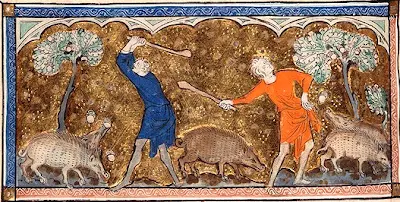
Pannage was a common right for peasants who were allowed to graze their pigs in the woods of the forest when the acorns fell and for a period of time after. This season was decided at the Verderers Court (see Forest Law page for more details) and the numbers of pigs were monitored by Agisters who acted as tax collectors.
This entry shows that with the demise of the Forest Eyre Courts by the time of 1440 (see 1287 Sherwood Forest Eyre Court and 1334 Sherwood Forest Eyre Court entries); how breaches of the forest law were dealt with.
The Keeper of the Forest here brought complaint before the Nottingham Court to gain the money back from the accused, caused by the trespass and damage to the park.
http://sherwoodforesthistory.blogspot.ca/2012/03/trespass-in-bestwood-park-in-1440.html
http://sherwoodforesthistory.blogspot.ca/2012/02/1287-sherwood-forest-eyre-court.html
http://sherwoodforesthistory.blogspot.ca/2011/12/1334-sherwood-forest-eyre-court.html
FoD - Deciduous Forest - Ray Mears
https://www.youtube.com/watch?v=bhnBhObR5QU
Forests, Woodsmen, Hunters, Miners, Ironworkers
https://www.youtube.com/playlist?list=PL745-VcJ1xdWc4CiWxovU2RNTVn4FvsOT
Forest & Woodland Resources - LINKS
https://plus.google.com/+SuttonHoo/posts/b4U7svx5moe
Town & Country: Forests, Woodsmen, Hunters - LINKS
https://plus.google.com/+SuttonHoo/posts/i2yvE7kZmEJ
Intensification: Oasthouses
https://plus.google.com/+SuttonHoo/posts/9WF4oELcJr4
Wye Valley Woodland (AONB) Wales - Trees woods & forest gardens - agroforestry arboriculture
https://www.youtube.com/playlist?list=PL3hm4LtH_-dogYqTZdrKfhRCUNlwowYmq
Charcoal, coppice, edibles, timber - Tony Blake
https://www.youtube.com/playlist?list=PLtakTnKQQMCzq3gN7I0H5RaM8_DCFWpPz
Ancient Woodland & Value of Trees - antharch
https://www.youtube.com/playlist?list=PLEFMsUiiH110nbFULj5JDl_0nqdm4tbdx
https://plus.google.com/+SuttonHoo/posts/b4U7svx5moe
Bite sized New Forest - New Forest National Park Authority
https://www.youtube.com/playlist?list=PLPERa4Ls5ArrEIV-owtlAIcVPAhcbNC2p
The Weald
https://plus.google.com/+SuttonHoo/posts/dU2mRRiPnj6
https://www.youtube.com/user/highwealdAONB/videos
Hunting scene - Archaeology & History of Medieval Sherwood Forest
http://news.experiencenottinghamshire.com/archaeology-and-history-of-medieval-sherwood-forest/
Medieval Forest of Dean
Forest of Dean
https://plus.google.com/103755316640704343614/posts/GPK5jBvrtux
Forest of Dean 1282 = pre-perambulation
https://plus.google.com/103755316640704343614/posts/fNBkJjHTPeV
St Briavels Hundred
https://plus.google.com/103755316640704343614/posts/F2NzWPbjEVH
Westbury Hundred
https://plus.google.com/103755316640704343614/posts/jBCxzoeeLKx
The area's history is obscure for several centuries after Roman period during the so-called Dark Ages, although at different times it may have been part of the Welsh kingdoms of Gwent and Ergyng, and the Beachley and Lancaut peninsulas east of the Lower Wye remained in Welsh control at least until the 8th century.
Around 790 the Saxon King Offa of Mercia built his dyke high above the Wye, to mark the boundary with the Welsh. The Forest of Dean then came under the control of the diocese of Hereford. Throughout the next few centuries Vikings conducted raids up the Severn, but by the 11th century the kingdom of Wessex had established civil government. The core of the forest was used by the late Anglo Saxon kings, and after 1066 the Normans, as their personal hunting ground. The area was kept stocked with deer and wild boar and became important for timber, charcoal, iron ore and limestone.
The Hundred of St Briavels was established in the 12th century, at the same time as many Norman laws concerning the Forest of Dean were put in place. St Briavels Castle became the Forest's administrative and judicial centre. Verderers were appointed to act for the king and protect his royal rights, and local people were given some common rights.
Flaxley Abbey was built and given rights and privileges. In 1296, miners from the Hundred of St Briavels supported King Edward I at the siege of Berwick-on-Tweed in the Scottish Wars of Independence by undermining the then Scottish town's defences in the first step of his campaign to seize Scotland from John Balliol. As a result, the king granted free mining rights within the forest to the miners and their descendants; the rights continue to the present day. Miners at that time were mainly involved in iron mining although the presence of coal was well known and limited amounts had been recovered in Roman times. Coal was not used for iron making with the methods of smelting then in use. Later the freeminer rights were used mainly for coal mining. The activities of the miners were regulated by the Court of Mine Law.
Forest of Dean - Wikipedia


Subscribe to:
Posts (Atom)