
Showing posts with label Jews. Show all posts
Showing posts with label Jews. Show all posts
Spanish Inquisition
Ugly History: Spanish Inquisition - TED-Ed > .
In 1478, Pope Sixtus IV issued a decree authorizing the Catholic monarchs, Ferdinand and Isabella, to root out "heresy" in the Spanish kingdoms. The inquisition quickly turned its attention to ridding the region of people who were not part of the Catholic Church— leading to more than 350 years of ethnic cleansing. Kayla Wolf digs into the persecution and brutality of the Spanish Inquisition.

ЖЉ Black Death - Jewish Persecution, Europe
.Life After the Black Death Ended - Weird > .
Black Death - Jewish Persecution, Europe
How did Medieval People respond to the Black Death? - same > .
The arrival of the plague in medieval Europe marked the beginning of one of the most devastating events humanity had ever experienced. In the face of an implacable and unstoppable enemy for which there seemed no defense and no cure, people responded in just about every way you can imagine. Some people engaged in denial, some turned to religion, and some decided to party. But others looked for someone to blame—and they found their scapegoat in the Jewish communities that existed throughout the medieval world.
Anti-Semitism
https://guidebookstgc.snagfilms.com/8241_BlackDeath.pdf
How did Medieval People respond to the Black Death? - same > .
The arrival of the plague in medieval Europe marked the beginning of one of the most devastating events humanity had ever experienced. In the face of an implacable and unstoppable enemy for which there seemed no defense and no cure, people responded in just about every way you can imagine. Some people engaged in denial, some turned to religion, and some decided to party. But others looked for someone to blame—and they found their scapegoat in the Jewish communities that existed throughout the medieval world.
Anti-Semitism
https://guidebookstgc.snagfilms.com/8241_BlackDeath.pdf

𝕸 Government & Law - Medieval
Agisters, Verderers, Medieval Forest of Dean, New Forest ..
Barter & Coinage in Britain ➧
Estates of the Realm ..Evolution of English Law ..
Collateral consanguinity ..
Crime & Punishment in Anglo-Saxon England ..
Common Law ..
Crime & Punishment ..Crime & Punishment in Anglo-Saxon England ..
Curtilage ..
Daily Life ..
1689 Declaration of Right ..
Economic & Societal Consequences of Black Death ..Estates of the Realm ..
Law and Order in Anglo-Saxon England ➧
Leges Henrici Primi ..
Leges Henrici Primi ..
Medieval World: Church, Commerce, Education, Parliament ..
₤ Prices ..
Provisions of Oxford - Mad Parliament ..
Punishment, Prisons in Ancient Rome ➧
Records, Feudal, Legal System ..
Richard II and the Governance of London .. Punishment, Prisons in Ancient Rome ➧
Records, Feudal, Legal System ..
St. Briavels hundred ..
Tally sticks, Foils, Counterfoils ..
Thirlage - Scotland | Mill Soke - England ..
Tally sticks, Foils, Counterfoils ..
Thirlage - Scotland | Mill Soke - England ..
Walsingham (Elizabeth I's spymaster) .. Westminster Palace - History ..
Educational Systems
Cathedrals, Colleges, Universities ..
Educational Routes circa 1000 ..
Formal Education in the Middle Ages ..
Héloïse and Abelard ..
Learning, Work ..
Formal Education in the Middle Ages ..
Héloïse and Abelard ..
Learning, Work ..
Medieval Universities ..
Scholasticism ..
Scholasticism (2) ..
Student Life in the Medieval University ..
Scholasticism, Natural Philosophy, Universities ..
Universities - Medieval ..
University - Medieval ..
Scholasticism (2) ..
Student Life in the Medieval University ..
Scholasticism, Natural Philosophy, Universities ..
Universities - Medieval ..
University - Medieval ..
Medieval Life, Law, Economy
Љ Hereford, 1290 Expulsion
Hereford
Љ Hereford ..
The Jewish Community in Hereford (England), up to 1290.
The Expulsion
In 1290, Edward I sent secret orders to the sheriff that all Jews, with their wives, children and chattels, were, on pain of death, to quit the realm by 1 November, the feast of All Saints. The sheriff was to ensure that they suffered no injury, harm, damage or grievance in their departure. The penalty for any Jew who remained behind after that was death.
Paris was the goal of the wealthiest, but in February 1291 Philip the Fair expelled all English Jews from his lands except those profitable to the French crown . It is not known what became of Hereford's Jews.
· The Expulsion was announced on 18th April, which, that year, fell on the 9th of Av, on the Jewish calendar. The 9th of Av is Tisha BaAv, a day of fasting, since it was also the date of the destruction of 1st and 2nd Temples. (see Jewish Feasts or holidays )
http://www.wildolive.co.uk/hereford_history.htm
https://en.wikipedia.org/wiki/Statute_of_the_Jewry
https://en.wikipedia.org/wiki/Edict_of_Expulsion
The Location of Hereford’s Jewry
English medieval Jewries were not ghettos.
1 Jewry Lane - centre of the community.
2 Maylord Street
3 Home of Moses -leader of community
4 Bewell Spring -site of mikveh?
5 Bye Street - home of Manasser and house in dowry of daughter of Hamo.
6 Bastion known as the Jew's Chimney
Off South East corner - site of cemetery
Archaeology has not produced much evidence but records can tell us quite a lot.
After the expulsion, Reginald Moniword and William de Pedwardyn bought up Aaron's house, the synagogue and most of the other property in Hereford. The cemetery was incorporated into St. Giles' Hospital. Thus ended the 110-year-old community cherished first by Hamo and his family and later by Aaron. The community was remembered in common usage of place names for six centuries.
http://www.wildolive.co.uk/hereford_history.htm
http://www.wildolive.co.uk/images/Hereford%20Jewry.jpg .
Hereford
http://www.british-history.ac.uk/rchme/heref/vol1/pp90-144
secular
http://www.british-history.ac.uk/rchme/heref/vol1/pp90-144#h3-0003
Map of Hereford, 1885 - 1886
https://www.francisfrith.com/hereford
https://en.wikipedia.org/wiki/Jewish_ghettos_in_Europe
https://en.wikipedia.org/wiki/Hereford
https://en.wikipedia.org/wiki/History_of_Herefordshire .
Medieval Antisemitism: An Introduction ~Dr Lackner > .
Љ Hereford ..
The Jewish Community in Hereford (England), up to 1290.
The Expulsion
In 1290, Edward I sent secret orders to the sheriff that all Jews, with their wives, children and chattels, were, on pain of death, to quit the realm by 1 November, the feast of All Saints. The sheriff was to ensure that they suffered no injury, harm, damage or grievance in their departure. The penalty for any Jew who remained behind after that was death.
Paris was the goal of the wealthiest, but in February 1291 Philip the Fair expelled all English Jews from his lands except those profitable to the French crown . It is not known what became of Hereford's Jews.
· The Expulsion was announced on 18th April, which, that year, fell on the 9th of Av, on the Jewish calendar. The 9th of Av is Tisha BaAv, a day of fasting, since it was also the date of the destruction of 1st and 2nd Temples. (see Jewish Feasts or holidays )
http://www.wildolive.co.uk/hereford_history.htm
https://en.wikipedia.org/wiki/Statute_of_the_Jewry
https://en.wikipedia.org/wiki/Edict_of_Expulsion
The Location of Hereford’s Jewry
English medieval Jewries were not ghettos.
1 Jewry Lane - centre of the community.
2 Maylord Street
3 Home of Moses -leader of community
4 Bewell Spring -site of mikveh?
5 Bye Street - home of Manasser and house in dowry of daughter of Hamo.
6 Bastion known as the Jew's Chimney
Off South East corner - site of cemetery
Archaeology has not produced much evidence but records can tell us quite a lot.
After the expulsion, Reginald Moniword and William de Pedwardyn bought up Aaron's house, the synagogue and most of the other property in Hereford. The cemetery was incorporated into St. Giles' Hospital. Thus ended the 110-year-old community cherished first by Hamo and his family and later by Aaron. The community was remembered in common usage of place names for six centuries.
http://www.wildolive.co.uk/hereford_history.htm
http://www.wildolive.co.uk/images/Hereford%20Jewry.jpg .
Hereford
http://www.british-history.ac.uk/rchme/heref/vol1/pp90-144
secular
http://www.british-history.ac.uk/rchme/heref/vol1/pp90-144#h3-0003
Map of Hereford, 1885 - 1886
https://www.francisfrith.com/hereford
https://en.wikipedia.org/wiki/Jewish_ghettos_in_Europe
https://en.wikipedia.org/wiki/Hereford
https://en.wikipedia.org/wiki/History_of_Herefordshire .
Medieval Antisemitism: An Introduction ~Dr Lackner > .

Milestones in Medieval Law
Common Law - persistence of Anglo-Saxon law under Anglo-Normans
Documents & Laws
~1150 - Gratian’s Decretum
In the mid-12th century the scholar Gratian completed his Decretum, which was a compilation of canon law. Legal scholar Harold J. Berman has called it “the first comprehensive and systematic legal treatise in the history of the West, and perhaps in the history of mankind.”
https://en.wikipedia.org/wiki/Decretum_Gratiani
1166 - The Assize of Clarendon
Created by King Henry II in 1166, this law enhanced the power of royal courts over ecclesiastical courts in judging various serious crimes including murder and robbery. The concept of juries was first established with the Assize of Clarendon, “providing the blueprint fro one of the most significant procedural components of criminal law.”
https://en.wikipedia.org/wiki/Assize_of_Clarendon
1215 - Magna Carta
While the famous document from 1215 was soon voided by the Pope, and ignored by the King and Barons just after it was issued, Magna Carta has long since inspired and moulded legal thinking. According to legal journalist James Podgers, “that King John agreed to sign a document affirming the principle that no one, not even a monarch, is above the law was historic.” Legal scholar A.E. Dick Howard notes that the document had “enormous significance in the development of one of our most precious ideals: rule of law, a government of laws and not of men.”
Magna Carta 1215 - barons, church to parliament
Tam
https://www.youtube.com/playlist?list=PLs5H4V1x-xBiUBMll7yPx4KQNsQzZG-HT
1215 - Canon 18 of Fourth Lateran Council spelled end for Trial by Ordeal
Charter of the Forests, 1217, Henry I [1225]
1258 - Provisions of Oxford were constitutional reforms developed in 1258 to resolve a dispute beween the English barons and King Henry III. They asserted the right of the barons to representation in the king's government and, like the earlier Magna Carta, demonstrated the ability of the barons to press their concerns in opposition to the monarchy.
https://en.wikipedia.org/wiki/Provisions_of_Oxford
1275 - Statute of the Jewry: Edward I of England outlawed the practice of usury
1290 - The Edict of Expulsion was a royal decree issued by King Edward I of England on 18 July 1290, expelling all Jews from the Kingdom of England.
1275, 1285, 1290 - The Statutes of Westminster
The cornerstones for Edward I’s reputation as one of the most important monarchs in England’s legal history were the the Statutes of Westminster. The first set of laws were issued in 1275, followed by other sets in 1285 and 1290.
● Statute of Westminster 1275, often called the Statute of Westminster I, codified existing law in England in 51 chapters
● Statute of Westminster 1285, often called the Statute of Westminster II, contained the clause De donis conditionalibus
● Quia Emptores of 1290, often called the Statute of Westminster III, prevented tenants from alienating their lands to others by subinfeudation
● Statute of Westminster 1327, first mentioned the military post of Conductor
● Statute of Westminster 1472, mostly noted for requiring ships coming to an English port to bring a tax in bowstaves
● Statute of Westminster 1931, established legislative equality for the self-governing dominions of the British Empire with the United Kingdom
https://en.wikipedia.org/wiki/Statute_of_Westminster
Lex mercatoria
1303 - Edward I - Carta Mercatoria
As trade continued to increase in medieval Europe, merchants were coming up with informal customs and practices that would serve as their own law. “These rules,” Roffer explains, “collectively the lex mercatoria, or merchant law – became the governing doctrine for resolving commercial disputes in merchant courts that arose along major trading routes.” Many scholars view it as one of the precursors to the concept of international law.
https://en.wikipedia.org/wiki/Lex_mercatoria
~1398 The Star Chamber
Emerging in the second half of the 14th century, it was created by the King’s Council to allow for regular citizens to seek justice against even the most powerful men of the real. Gradually the seven men who sat in the court began to wield important power, including the ability to create new laws. “For example,” Roffer writes, “it made crimes of libel, perjury, and conspiracy. However appropriate or necessary such laws were, the process inhibited political dissent and criminalized the expression of certain opinions.” The Court of the Star Chamber would continue to operate until 1640.
https://en.wikipedia.org/wiki/Star_Chamber
1431 - Trial of Joan of Arc
Perhaps the most well-known trial of the Middle Ages, it took place in 1431 after Joan was captured and imprisoned by the English and their allies. In order to discredit the teenager, who had led French forces to a series of military victories just months earlier, she was put on trial for heresy.
https://www.youtube.com/watch?v=hr0anFEyP2U
https://www.youtube.com/watch?v=C4_KDf4xhU8
https://en.wikipedia.org/wiki/Trial_of_Joan_of_Arc
http://www.medievalists.net/2017/05/10-milestones-medieval-law/
Dissolution of the Monasteries
The Court of Augmentations, also called Augmentation Court or simply The Augmentation, was established during the reign of King Henry VIII of England along with three lesser courts (those of General Surveyors, First Fruit and Tenths, and Wards and Liveries) following the dissolution of the monasteries. Its primary function was to gain better control over the land and finances formerly held by the Roman Catholic Church in the kingdom. It was incorporated into the Exchequer in 1554 as the augmentation office.
https://en.wikipedia.org/wiki/Court_of_Augmentations .
https://en.wikipedia.org/wiki/Category:Dissolution_of_the_Monasteries .
King John and Magna Carta - HiHu >> .
Legal Landmarks - HiHu >> .
Legal History
Legal Landmarks - HiHu >> .
Medieval Documents : 400 - 1399
http://avalon.law.yale.edu/subject_menus/medieval.asp
Common Law and Equity: A Very Short History
https://www.slideshare.net/mblemieux/common-law-and-equity-a-very-short-history
Forest Law -- Forest of Dean
Forest Law & Forest of Dean ..
Forest of Dean & Forest Law ..
Land tenure
Burgage ..
Land tenure - English feudal system
Land tenure under the English feudal system ..
Danelaw - carucate / hide
Farming-base units of measurement ..
History of English Land Law
History of English land law ..
Expulsion of Jews from England
Љ Hereford, 1290 Expulsion ..
Henry II - legal reforms
https://www.slideshare.net/georginablair/henry-ii-assizes
Habeas corpus (1305) -- Assize of Clarendon (1166)
The Assize of Clarendon was an 1166 act of Henry II of England that began the transformation of English law from such systems for deciding the prevailing party in a case, especially felonies, as trial by ordeal or trial by battle or trial by compurgation to an evidentiary model, in which evidence, inspection, and inquiry was made by laymen, knights or ordinary freemen, under oath. This act greatly fostered the methods that would eventually be known in common law countries as trial by jury.
The Assize of Clarendon did not lead to this change immediately, however; recourse to trial by combat was not officially rescinded until 1819.
The Assize takes its name from Clarendon Palace, Wiltshire, the royal hunting lodge at which it was promulgated.
https://en.wikipedia.org/wiki/Assize_of_Clarendon
http://avalon.law.yale.edu/medieval/assizecl.asp
In the 17th century the foundations for habeas corpus were "wrongly thought" to have originated in Magna Carta. This charter declared that:
"No Freeman shall be taken or imprisoned, or be disseized of his Freehold, or Liberties, or free Customs, or be outlawed, or exiled, or any other wise destroyed; nor will We not pass upon him, nor condemn him, but by lawful judgment of his Peers, or by the Law of the land."
William Blackstone cites the first recorded usage of habeas corpus ad subjiciendum in 1305, during the reign of King Edward I. However, other writs were issued with the same effect as early as the reign of Henry II in the 12th century. Blackstone explained the basis of the writ, saying "[t]he king is at all times entitled to have an account, why the liberty of any of his subjects is restrained, wherever that restraint may be inflicted." The procedure for issuing a writ of habeas corpus was first codified by the Habeas Corpus Act 1679, following judicial rulings which had restricted the effectiveness of the writ. A previous law (the Habeas Corpus Act 1640) had been passed forty years earlier to overturn a ruling that the command of the King was a sufficient answer to a petition of habeas corpus.
Then, as now, the writ of habeas corpus was issued by a superior court in the name of the Sovereign, and commanded the addressee (a lower court, sheriff, or private subject) to produce the prisoner before the royal courts of law. A habeas corpus petition could be made by the prisoner him or herself or by a third party on his or her behalf and, as a result of the Habeas Corpus Acts, could be made regardless of whether the court was in session, by presenting the petition to a judge. Since the 18th century the writ has also been used in cases of unlawful detention by private individuals, most famously in Somersett's Case (1772), where the black slave Somersett was ordered to be freed. In that case these famous words are said to have been uttered: "The air of England has long been too pure for a slave, and every man is free who breathes it". During the Seven Years' War and later conflicts, the Writ was used on behalf of soldiers and sailors pressed into military and naval service. The Habeas Corpus Act 1816 introduced some changes and expanded the territoriality of the legislation.
The privilege of habeas corpus has been suspended or restricted several times during English history, most recently during the 18th and 19th centuries. Although internment without trial has been authorised by statute since that time, for example during the two World Wars and the Troubles in Northern Ireland, the habeas corpus procedure has in modern times always technically remained available to such internees. However, as habeas corpus is only a procedural device to examine the lawfulness of a prisoner's detention, so long as the detention is in accordance with an Act of Parliament, the petition for habeas corpus is unsuccessful. Since the passage of the Human Rights Act 1998, the courts have been able to declare an Act of Parliament to be incompatible with the European Convention on Human Rights, but such a declaration of incompatibility has no legal effect unless and until it is acted upon by the government.
The wording of the writ of habeas corpus implies that the prisoner is brought to the court for the legality of the imprisonment to be examined. However, rather than issuing the writ immediately and waiting for the return of the writ by the custodian, modern practice in England is for the original application to be followed by a hearing with both parties present to decide the legality of the detention, without any writ being issued. If the detention is held to be unlawful, the prisoner can usually then be released or bailed by order of the court without having to be produced before it. It is also possible for individuals held by the state to petition for judicial review, and individuals held by non-state entities to apply for an injunction[citation needed]. With the development of modern public law, applications for habeas corpus have been to some extent discouraged, in favour of applications for judicial review.
The writ, however, maintains its vigour, and was held by the UK Supreme Court to be available in respect of a prisoner captured by British forces in Afghanistan, albeit that the Secretary of State made a valid return to the writ justifying the detention of the claimant.
https://en.wikipedia.org/wiki/Habeas_corpus#Origins_in_England
http://legalhistorysources.com/Law508/CommonLawsEurope.htm
http://legalhistorysources.com/Law508/EnglishLawHistory.htm
Thirteenth-century text by English jurist Bracton, De legibus et consuetudinibus Angliae
Bracton's chief claim to fame is his association with the long treatise De legibus et consuetudinibus Angliae (On the Laws and Customs of England), which the noted legal historian F.W. Maitland described as "the crown and flower of English jurisprudence." The work (commonly known now simply as Bracton) attempts to describe rationally the whole of English law, a task that was not again undertaken until Blackstone's Commentaries on the Laws of England in the eighteenth century. The work is remarkable both for its wealth of detail and for its attempts to make sense out of English law largely in terms of the ius commune, the combination of Roman and canon law that was taught in the universities in Bracton's time.
While the attribution of the work to Bracton is of considerable antiquity, it now seems that the bulk of the work was written in the 1220's and 1230's by persons other than Bracton himself. It seems then to have been edited and partially updated in the late 1230's, with various additions being made to it between that time and the 1250's. The last owner of the original manuscript and the author of the later additions was probably Bracton.
http://www.law.harvard.edu/programs/ames_foundation/bracton.html
http://bracton.law.harvard.edu/
http://bracton.law.harvard.edu/Common/SearchPage.htm .
Medieval Documents : 400 - 1399
http://avalon.law.yale.edu/subject_menus/medieval.asp
Common Law and Equity: A Very Short History
https://www.slideshare.net/mblemieux/common-law-and-equity-a-very-short-history
Forest Law -- Forest of Dean
Forest Law & Forest of Dean ..
Forest of Dean & Forest Law ..
Land tenure
Burgage ..
Land tenure - English feudal system
Land tenure under the English feudal system ..
Danelaw - carucate / hide
Farming-base units of measurement ..
History of English Land Law
History of English land law ..
Expulsion of Jews from England
Љ Hereford, 1290 Expulsion ..
Henry II - legal reforms
https://www.slideshare.net/georginablair/henry-ii-assizes
Habeas corpus (1305) -- Assize of Clarendon (1166)
The Assize of Clarendon was an 1166 act of Henry II of England that began the transformation of English law from such systems for deciding the prevailing party in a case, especially felonies, as trial by ordeal or trial by battle or trial by compurgation to an evidentiary model, in which evidence, inspection, and inquiry was made by laymen, knights or ordinary freemen, under oath. This act greatly fostered the methods that would eventually be known in common law countries as trial by jury.
The Assize of Clarendon did not lead to this change immediately, however; recourse to trial by combat was not officially rescinded until 1819.
The Assize takes its name from Clarendon Palace, Wiltshire, the royal hunting lodge at which it was promulgated.
https://en.wikipedia.org/wiki/Assize_of_Clarendon
http://avalon.law.yale.edu/medieval/assizecl.asp
In the 17th century the foundations for habeas corpus were "wrongly thought" to have originated in Magna Carta. This charter declared that:
"No Freeman shall be taken or imprisoned, or be disseized of his Freehold, or Liberties, or free Customs, or be outlawed, or exiled, or any other wise destroyed; nor will We not pass upon him, nor condemn him, but by lawful judgment of his Peers, or by the Law of the land."
William Blackstone cites the first recorded usage of habeas corpus ad subjiciendum in 1305, during the reign of King Edward I. However, other writs were issued with the same effect as early as the reign of Henry II in the 12th century. Blackstone explained the basis of the writ, saying "[t]he king is at all times entitled to have an account, why the liberty of any of his subjects is restrained, wherever that restraint may be inflicted." The procedure for issuing a writ of habeas corpus was first codified by the Habeas Corpus Act 1679, following judicial rulings which had restricted the effectiveness of the writ. A previous law (the Habeas Corpus Act 1640) had been passed forty years earlier to overturn a ruling that the command of the King was a sufficient answer to a petition of habeas corpus.
Then, as now, the writ of habeas corpus was issued by a superior court in the name of the Sovereign, and commanded the addressee (a lower court, sheriff, or private subject) to produce the prisoner before the royal courts of law. A habeas corpus petition could be made by the prisoner him or herself or by a third party on his or her behalf and, as a result of the Habeas Corpus Acts, could be made regardless of whether the court was in session, by presenting the petition to a judge. Since the 18th century the writ has also been used in cases of unlawful detention by private individuals, most famously in Somersett's Case (1772), where the black slave Somersett was ordered to be freed. In that case these famous words are said to have been uttered: "The air of England has long been too pure for a slave, and every man is free who breathes it". During the Seven Years' War and later conflicts, the Writ was used on behalf of soldiers and sailors pressed into military and naval service. The Habeas Corpus Act 1816 introduced some changes and expanded the territoriality of the legislation.
The privilege of habeas corpus has been suspended or restricted several times during English history, most recently during the 18th and 19th centuries. Although internment without trial has been authorised by statute since that time, for example during the two World Wars and the Troubles in Northern Ireland, the habeas corpus procedure has in modern times always technically remained available to such internees. However, as habeas corpus is only a procedural device to examine the lawfulness of a prisoner's detention, so long as the detention is in accordance with an Act of Parliament, the petition for habeas corpus is unsuccessful. Since the passage of the Human Rights Act 1998, the courts have been able to declare an Act of Parliament to be incompatible with the European Convention on Human Rights, but such a declaration of incompatibility has no legal effect unless and until it is acted upon by the government.
The wording of the writ of habeas corpus implies that the prisoner is brought to the court for the legality of the imprisonment to be examined. However, rather than issuing the writ immediately and waiting for the return of the writ by the custodian, modern practice in England is for the original application to be followed by a hearing with both parties present to decide the legality of the detention, without any writ being issued. If the detention is held to be unlawful, the prisoner can usually then be released or bailed by order of the court without having to be produced before it. It is also possible for individuals held by the state to petition for judicial review, and individuals held by non-state entities to apply for an injunction[citation needed]. With the development of modern public law, applications for habeas corpus have been to some extent discouraged, in favour of applications for judicial review.
The writ, however, maintains its vigour, and was held by the UK Supreme Court to be available in respect of a prisoner captured by British forces in Afghanistan, albeit that the Secretary of State made a valid return to the writ justifying the detention of the claimant.
https://en.wikipedia.org/wiki/Habeas_corpus#Origins_in_England
http://legalhistorysources.com/Law508/CommonLawsEurope.htm
http://legalhistorysources.com/Law508/EnglishLawHistory.htm
Thirteenth-century text by English jurist Bracton, De legibus et consuetudinibus Angliae
Bracton's chief claim to fame is his association with the long treatise De legibus et consuetudinibus Angliae (On the Laws and Customs of England), which the noted legal historian F.W. Maitland described as "the crown and flower of English jurisprudence." The work (commonly known now simply as Bracton) attempts to describe rationally the whole of English law, a task that was not again undertaken until Blackstone's Commentaries on the Laws of England in the eighteenth century. The work is remarkable both for its wealth of detail and for its attempts to make sense out of English law largely in terms of the ius commune, the combination of Roman and canon law that was taught in the universities in Bracton's time.
While the attribution of the work to Bracton is of considerable antiquity, it now seems that the bulk of the work was written in the 1220's and 1230's by persons other than Bracton himself. It seems then to have been edited and partially updated in the late 1230's, with various additions being made to it between that time and the 1250's. The last owner of the original manuscript and the author of the later additions was probably Bracton.
http://www.law.harvard.edu/programs/ames_foundation/bracton.html
http://bracton.law.harvard.edu/
http://bracton.law.harvard.edu/Common/SearchPage.htm .

𝕸 Economy
Daily Life ..
Economic History ..Economy of Roman Empire ➧
European Bank Money Creation - History ..
guild ..
Medieval Banking ..
Papyrus ..
₤ Prices ..
Tudor Xmas ..
Urban & Commercial Life in Medieval England and Europe ..
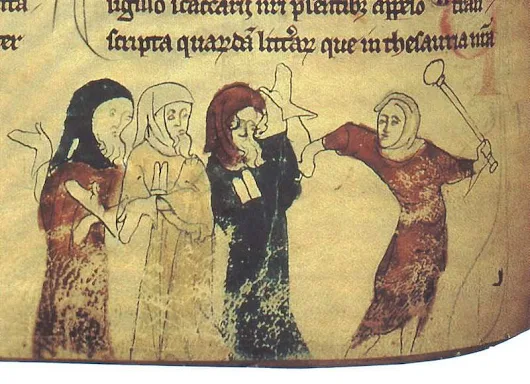
Usury, moneylending - Statute of the Jewry 1275, Edict of Expulsion 1290 ..
Usury, moneylending - Statute of the Jewry 1275, Edict of Expulsion 1290 ..
Circular Economy
Educational Systems
Usury, moneylending - Statute of the Jewry 1275, Edict of Expulsion 1290
Usury to moneylending, prejudice, and royal robbery
Medieval Antisemitism: An Introduction ~Dr Lackner > .
Varied History of Medieval Guilds - Modern History TV > .
The Statute of the Jewry was a statute issued by Edward I of England in 1275. It placed a number of restrictions on Jews of England, most notably outlawing the practice of usury.
https://en.wikipedia.org/wiki/Statute_of_the_Jewry .
Lending money has long been regarded as a moral matter. Hundreds of years ago, when modern finance arose in Europe, moneylenders moderated their behaviour in response to debates among the clergy about how to apply the Bible’s teachings to an increasingly complex economy.
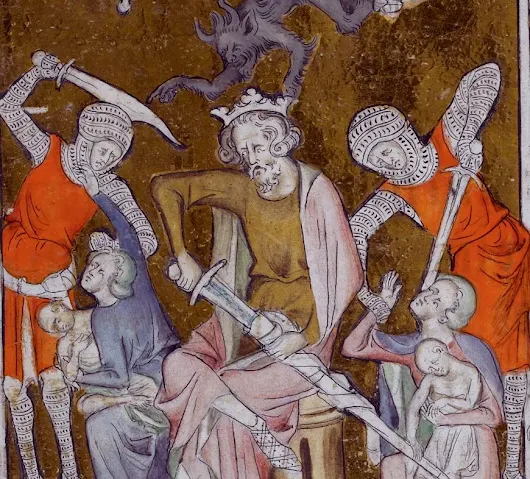
The Edict of Expulsion was a royal decree issued by King Edward I of England on 18 July 1290, expelling all Jews from the Kingdom of England. The expulsion edict remained in force for the rest of the Middle Ages. The edict was not an isolated incident, but the culmination of over 200 years of increased persecution. The edict was overturned during the Protectorate more than three centuries later, when Oliver Cromwell permitted Jews to return to England in 1657.
https://en.wikipedia.org/wiki/Edict_of_Expulsion .
The Jews in England - 1066 to 1290
http://www.wildolive.co.uk/england_history.htm .
Medieval Antisemitism in Jewish History
https://www.youtube.com/watch?v=v5qLnsEER4c .
The Statute of the Jewry was a statute issued by Edward I of England in 1275. It placed a number of restrictions on Jews of England, most notably outlawing the practice of usury.
https://en.wikipedia.org/wiki/Statute_of_the_Jewry .
Lending money has long been regarded as a moral matter. Hundreds of years ago, when modern finance arose in Europe, moneylenders moderated their behaviour in response to debates among the clergy about how to apply the Bible’s teachings to an increasingly complex economy.
The Edict of Expulsion was a royal decree issued by King Edward I of England on 18 July 1290, expelling all Jews from the Kingdom of England. The expulsion edict remained in force for the rest of the Middle Ages. The edict was not an isolated incident, but the culmination of over 200 years of increased persecution. The edict was overturned during the Protectorate more than three centuries later, when Oliver Cromwell permitted Jews to return to England in 1657.
https://en.wikipedia.org/wiki/Edict_of_Expulsion .
The Jews in England - 1066 to 1290
http://www.wildolive.co.uk/england_history.htm .
Medieval Antisemitism in Jewish History
https://www.youtube.com/watch?v=v5qLnsEER4c .

Љ Hereford
http://www.wildolive.co.uk/hereford_history.htm
https://en.wikipedia.org/wiki/Statute_of_the_Jewry
https://en.wikipedia.org/wiki/Edict_of_Expulsion
The Jewish Community in Hereford (England), up to 1290.
The Expulsion
In 1290, Edward I sent secret orders to the sheriff that all Jews, with their wives, children and chattels, were, on pain of death, to quit the realm by 1 November, the feast of All Saints. The sheriff was to ensure that they suffered no injury, harm, damage or grievance in their departure. The penalty for any Jew who remained behind after that was death.
Paris was the goal of the wealthiest, but in February 1291 Philip the Fair expelled all English Jews from his lands except those profitable to the French crown . It is not known what became of Hereford's Jews.
· The Expulsion was announced on 18th April, which, that year, fell on the 9th of Av, on the Jewish calendar. The 9th of Av is Tisha BaAv, a day of fasting, since it was also the date of the destruction of 1st and 2nd Temples. (see Jewish Feasts or holidays )
http://www.wildolive.co.uk/hereford_history.htm
https://en.wikipedia.org/wiki/Statute_of_the_Jewry
https://en.wikipedia.org/wiki/Edict_of_Expulsion
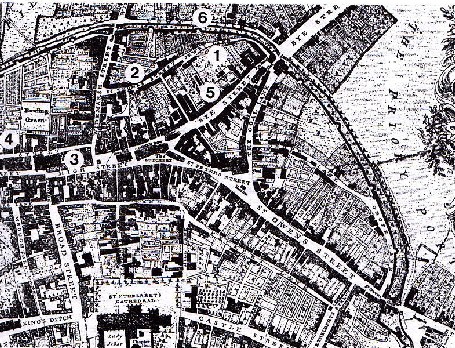
The Location of Hereford’s Jewry
English medieval Jewries were not ghettos.
1 Jewry Lane - centre of the community.
2 Maylord Street
3 Home of Moses -leader of community
4 Bewell Spring -site of mikveh?
5 Bye Street - home of Manasser and house in dowry of daughter of Hamo.
6 Bastion known as the Jew's Chimney
Off South East corner - site of cemetery
Archaeology has not produced much evidence but records can tell us quite a lot.
After the expulsion, Reginald Moniword and William de Pedwardyn bought up Aaron's house, the synagogue and most of the other property in Hereford. The cemetery was incorporated into St. Giles' Hospital. Thus ended the 110-year-old community cherished first by Hamo and his family and later by Aaron. The community was remembered in common usage of place names for six centuries.
http://www.wildolive.co.uk/hereford_history.htm
http://www.wildolive.co.uk/images/Hereford%20Jewry.jpg
Hereford
http://www.british-history.ac.uk/rchme/heref/vol1/pp90-144
secular
http://www.british-history.ac.uk/rchme/heref/vol1/pp90-144#h3-0003
Map of Hereford, 1885 - 1886
https://www.francisfrith.com/hereford
https://en.wikipedia.org/wiki/Jewish_ghettos_in_Europe
https://en.wikipedia.org/wiki/Hereford
https://en.wikipedia.org/wiki/History_of_Herefordshire
Hereford
https://www.youtube.com/watch?v=HexYWG0prtc
The River Wye at Hereford
https://www.youtube.com/watch?v=Y4Vp7MTnSrQ
Herefordshire - antharch
https://www.youtube.com/playlist?list=PLEFMsUiiH110oJt8EKpQlnD1-U4cxeQLo .
Subscribe to:
Posts (Atom)