Thomas Holland, 2nd Earl of Kent

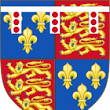
Thomas Holland (also known as de Holland), 2nd Earl of Kent, 3rd Baron Holand KG (1350/1354 – 25 April 1397) was an English nobleman and a councillor of his half-brother, King Richard II of England.

Thomas Holland (or de Holand) was born in Upholand, Lancashire, in 1350 or 1354. He was the eldest surviving son of Thomas Holland, 1st Earl of Kent, and Joan "The Fair Maid of Kent". His mother was a daughter of Edmund of Woodstock, 1st Earl of Kent, and Margaret Wake. Edmund was in turn a son of Edward I of England and his second Queen consort Marguerite of France, and thus a younger half-brother of Edward II of England.

His father died in 1360, and later that year, on 28 December, Thomas became Baron Holand. His mother was still Countess of Kent in her own right, and in 1361 she married Edward, the Black Prince, the son of King Edward III.

At sixteen, in 1366, Holland was appointed captain of the English forces in Aquitaine. Over the next decade he fought in various campaigns, including the Battle of Nájera, under the command of his stepfather Edward, the Black Prince. He was made a Knight of the Garter in 1375.

Richard II became king in 1377, and soon Holland acquired great influence over his younger half-brother, which he used for his own enrichment. In 1381, he succeeded as Earl of Kent.

On 10 April 1364 Holland married Lady Alice FitzAlan, daughter of Richard FitzAlan, 10th Earl of Arundel by his wife Eleanor of Lancaster. Lady Alice was later named as a Lady of the Garter. By his wife he had three sons and six daughters. All the sons died without legitimate children, whereupon the daughters and their issue became co-heiresses to the House of Holland.

https://en.wikipedia.org/wiki/Thomas_Holland,_2nd_Earl_of_Kent

Houses & Titles

Kings, Nobles, Gentry - 14th century

House of Plantagenet
https://mittelzeit.blogspot.com/2018/12/richard-ii-and-plantagenets.html .
https://en.wikipedia.org/wiki/House_of_Plantagenet .

House of Clare
https://mittelzeit.blogspot.com/2019/03/house-of-clare.html
https://en.wikipedia.org/wiki/De_Clare

House of Neville
https://mittelzeit.blogspot.com/2018/11/neville.html
https://en.wikipedia.org/wiki/House_of_Neville

Duke of Gloucester
https://mittelzeit.blogspot.com/2019/03/thomas-of-woodstock.html
https://en.wikipedia.org/wiki/Duke_of_Gloucester

Duke of Norfolk ..
When Richard II made Thomas Mowbray the Duke of Norfolk in 1397, he conferred upon him the estates and titles (including Earl Marshal) that had belonged to the Earls of Norfolk. His elderly grandmother Margaret was still alive, and so at the same time she was created Duchess of Norfolk for life. Mowbray died in exile in 1399, some months after his grandmother, and his dukedom was repealed. His widow took the title of Countess of Norfolk.
Edward le Despencer, 1st Baron le Despencer (1336–1375)
Thomas le Despencer, 2nd Baron le Despencer (1373–1400) (created Earl of Gloucester, 1397)(beneficiary of the reversal of the attainder of first and second creations in 1398; attainted 1400)


Photo

House of Clare

House of Clare

The Clare family of Norman lords were associated with the Welsh Marches, Suffolk, Surrey, Kent (especially Tonbridge) and Ireland. They were descended from Richard Fitz Gilbert, 1st Lord of Clare (1035-1090), who accompanied William the Conqueror (1028-1087) into England during the Norman conquest of England. In the paternal line they were descendants of the House of Normandy, through one of Richard I, Duke of Normandy's sons, Geoffrey de Brionne, 1st Count of Eu, 1st Count of Brionne. They became one of the most powerful and influential noble families of their time in England, Wales, and Ireland.

The coat and shield with the three chevrons was probably first used at the end of the 12th century.

In 1217–20 Gilbert de Clare, 4th Earl of Hertford, 5th Earl of Gloucester (died 1230), inherited the estates of William Fitz Robert, 2nd Earl of Gloucester (died 1183), including the earldom and honour of Gloucester and the lordship of Glamorgan. Gilbert de Clare was killed in the Battle of Bannockburn, becoming the first Clare to be buried in the chancel of Tewkesbury Abbey.

Richard de Clare, 2nd Earl of Pembroke (died 1176), known as Strongbow, had no sons and with his death this line came to an end, his many Irish and Welsh possessions passing to his daughter Isabel, who married William Marshal, (c. 1146 – 14 May 1219) who then became known as William Marshal, 1st Earl of Pembroke.

Gloucester's political importance did not end with his death; his disappearance from the political scene had immediate consequences. In his Welsh lordship of Glamorgan, the uncertain situation caused by his death caused a short-lived rebellion in 1316. In Ireland, where he also held large possessions, the power vacuum he left behind facilitated the 1315 invasion by Robert the Bruce's brother Edward. The greatest consequences, however, resulted from the division of the de Clare estates. In 1308, Gilbert de Clare had married Maud (or Matilda) de Burgh, the daughter of Richard de Burgh, Earl of Ulster. The couple left no surviving issue, so his death marked the end of the great de Clare family. The family lands were worth as much as £6,000, second only to those of the Earl of Lancaster among the nobility of the realm.

The lands went into royal possession while the matter of inheritance was being settled. By the entail of 1290, the lands could only be inherited by direct descendants of the seventh earl and Joan of Acre. Maud managed to postpone the proceedings by claiming to be pregnant, but by 1316 it was clear that this could not be the case. The late earl's sisters, Eleanor, Margaret (now widowed after the death of Gaveston) and Elizabeth were by 1317 all married to favourites of Edward II: Hugh Despenser the Younger, Hugh de Audley and Roger d'Amory respectively. The three were granted equal parts of the English possessions, but Despenser received the entire lordship of Glamorgan in Wales, politically the most important of the de Clare lands.

Not content with his part, Despenser used his relationship with the king to impinge on the lands of other Marcher lords. This caused resentment among such men as Hereford and Roger Mortimer, who rose up in rebellion in 1321. The rebellion was crushed, but resistance continued under the Marcher lords' ally Thomas of Lancaster, who was defeated at the Battle of Boroughbridge in 1322, and executed. Although this victory temporarily secured Edward's position on the throne, he was eventually deposed in 1326 by Roger Mortimer, with the help of the king's wife, Isabella of France. The title of Earl of Gloucester was recreated by Edward II's son Edward III in 1337, for Hugh de Audley.

https://en.wikipedia.org/wiki/De_Clare
https://en.wikipedia.org/wiki/Gilbert_de_Clare,_8th_Earl_of_Gloucester
https://en.wikipedia.org/wiki/Battle_of_Bannockburn
https://en.wikipedia.org/wiki/Richard_de_Clare,_2nd_Earl_of_Pembroke
https://en.wikipedia.org/wiki/Roger_Mortimer,_1st_Earl_of_March

Sir Thomas Mortimer (c. 1350–1403) illegitimate son of Roger Mortimer, 2nd Earl of March

Henry II, Thomas Becket

.Why Henry II Wanted Rid of Archbishop Thomas Becket | Timeline > .

Thomas Becket was appointed Chancellor by Henry II in 1155. In this job he proved himself to be a faithful member of the king’s court. When Theobald, the existing Archbishop of Canterbury died, Henry seized the chance to dominate the church by appointing the trustworthy Becket to succeed him.

Having a loyal friend in the most senior religious position in England made sense to Henry. However, as Archbishop of Canterbury, Becket’s allegiance quickly switched to siding with the church. This frustrated Henry who asked Becket to sign the Constitutions of Clarendon in 1164 to extend the king’s authority over the clergy. Becket refused and, shortly after being summoned to the king to explain his actions, fled to France.

Becket returned to England in 1170, but not before excommunicating two senior members of the clergy for supporting Henry. This act led to him being the target of an angry outburst by the king. It is highly unlikely, however, that Henry screamed out the words ‘Who will rid me of this troublesome priest?’

Whatever Henry said was enough to encourage four knights to travel to Canterbury and kill the Archbishop inside the Cathedral. The event was recorded in a later history by the monk Edward Grim. He claimed that the fatal blow split Becket’s skull as he knelt in front of the altar.

Becket was canonised by Pope Alexander III barely two years after the murder, and in 1174 the king himself walked barefoot to Becket’s tomb in Canterbury in penance.

Henry II

Henry II (5 March 1133 – 6 July 1189), also known as Henry Curtmantle (Court-manteau), Henry FitzEmpress, or Henry Plantagenet, was King of England from 1154 until his death in 1189. He was the first king of the House of Plantagenet. King Louis VII of France made him Duke of Normandy in 1150. Henry became Count of Anjou and Maine upon the death of his father, Count Geoffrey V, in 1151. His marriage in 1152 to Eleanor of Aquitaine, whose marriage to Louis VII had recently been annulled, made him Duke of Aquitaine. He became Count of Nantes by treaty in 1158. Before he was 40 he controlled England, large parts of Wales, the eastern half of Ireland and the western half of France; an area that was later called the Angevin Empire. At various times, Henry also partially controlled Scotland and the Duchy of Brittany.

Henry was the son of Geoffrey of Anjou and Matilda, daughter of Henry I of England. He became actively involved by the age of 14 in his mother's efforts to claim the throne of England, then occupied by Stephen of Blois, and was made Duke of Normandy at 17. He inherited Anjou in 1151 and shortly afterwards married Eleanor of Aquitaine, whose marriage to Louis VII of France had recently been annulled. Stephen agreed to a peace treaty after Henry's military expedition to England in 1153, and Henry inherited the kingdom on Stephen's death a year later.

Henry was an energetic and sometimes ruthless ruler, driven by a desire to restore the lands and privileges of his grandfather Henry I. During the early years of his reign the younger Henry restored the royal administration in England, re-established hegemony over Wales and gained full control over his lands in Anjou, Maine and Touraine. Henry's desire to reform the relationship with the Church led to conflict with his former friend Thomas Becket, the Archbishop of Canterbury. This controversy lasted for much of the 1160s and resulted in Becket's murder in 1170. Henry soon came into conflict with Louis VII and the two rulers fought what has been termed a "cold war" over several decades. Henry expanded his empire, often at Louis' expense, taking Brittany and pushing east into central France and south into Toulouse; despite numerous peace conferences and treaties, no lasting agreement was reached. By 1172, he controlled England, large parts of Wales, the eastern half of Ireland and the western half of France, an area that would later come to be called the Angevin Empire.

Henry and Eleanor had eight children. As they grew up, tensions over the future inheritance of the empire began to emerge, encouraged by Louis and his son King Philip II. In 1173 Henry's heir apparent, "Young Henry", rebelled in protest; he was joined by his brothers Richard and Geoffrey and by their mother, Eleanor. France, Scotland, Brittany, Flanders, and Boulogne allied themselves with the rebels. The Great Revolt was only defeated by Henry's vigorous military action and talented local commanders, many of them "new men" appointed for their loyalty and administrative skills. Young Henry and Geoffrey revolted again in 1183, resulting in Young Henry's death. The Norman invasion of Ireland provided lands for his youngest son John, but Henry struggled to find ways to satisfy all his sons' desires for land and immediate power. Philip successfully played on Richard's fears that Henry would make John king, and a final rebellion broke out in 1189. Decisively defeated by Philip and Richard and suffering from a bleeding ulcer, Henry retreated to Chinon castle in Anjou, where he died.

Henry's empire quickly collapsed during the reign of his youngest son John. Many of the changes Henry introduced during his long rule, however, had long-term consequences. Henry's legal changes are generally considered to have laid the basis for the English Common Law, while his intervention in Brittany, Wales and Scotland shaped the development of their societies and governmental systems. Historical interpretations of Henry's reign have changed considerably over time. In the 18th century, scholars argued that Henry was a driving force in the creation of a genuinely English monarchy and, ultimately, a unified Britain. During the Victorian expansion of the British Empire, historians were keenly interested in the formation of Henry's own empire, but they also expressed concern over his private life and treatment of Becket. Late-20th-century historians have combined British and French historical accounts of Henry, challenging earlier Anglo-centric interpretations of his reign.

https://en.wikipedia.org/wiki/Henry_II_of_England
https://en.wikipedia.org/wiki/Richard_I_of_England
https://en.wikipedia.org/wiki/John,_King_of_England